
GCSE Physics (AQA)
346 videos | 23 hours
Please subscribe to watch this video.
This, and all other videos, are included in our premium subscriptions.
Premium accounts get access to all videos.
Enable autoplay to keep watching
Your browser is blocking videos from playing automatically. To turn it back on:
Safari (Mac): Click the Safari menu item in the top bar, then Settings → Websites → Auto-Play, then set Auto-Play to Allow All Auto-Play for the current website.
Safari (iPhone/iPad): open the Settings app, then Apps → Safari → Auto-Play, and select Allow All Auto-Play.
Forces
Forces and elasticity
Elastic & Inelastic Deformations
2:59
Deformations and Springs
Spec
4.5.3
- Elastic deformation: change in shape where the object returns to its original shape after forces are removed.
- Example: Stretching a spring with forces in opposite directions, then releasing it to return to its original shape.
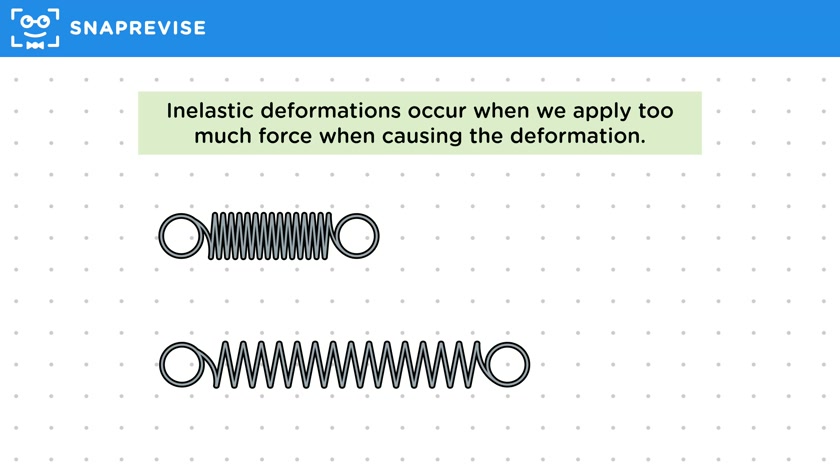
- Inelastic deformation: change in shape where the object does not return to its original shape after forces are removed.
- Example: A spring that remains longer after being extended and released.
- Inelastic deformations occur when particles are pulled apart enough to break bonds.
- Elastic deformation occurs with small forces that do not break bonds.
- Inelastic deformation occurs with larger forces that break bonds.
- Elastic bands typically snap back to their original shape but can break if overstretched.
- Cans can undergo elastic deformation with light forces, but inelastic deformation with larger forces.
- The material of an object determines the force needed for inelastic deformation.
- Understanding elastic and inelastic deformations is important for exams.
- Specific examples of deformation are not necessary to remember, but common examples may be analyzed in exams.
Please subscribe to access these revision notes.
This, and all other video notes, are included in our premium subscriptions.
Premium accounts get access to all videos and revision notes.
Report an Issue
Spotted something wrong? Let us know and we'll take a look.