
GCSE Physics (AQA)
346 videos | 23 hours
Please subscribe to watch this video.
This, and all other videos, are included in our premium subscriptions.
Premium accounts get access to all videos.
Enable autoplay to keep watching
Your browser is blocking videos from playing automatically. To turn it back on:
Safari (Mac): Click the Safari menu item in the top bar, then Settings → Websites → Auto-Play, then set Auto-Play to Allow All Auto-Play for the current website.
Safari (iPhone/iPad): open the Settings app, then Apps → Safari → Auto-Play, and select Allow All Auto-Play.
Electricity
Energy transfers
Efficiency of the National Grid
2:27
The National Grid
Spec
4.2.4.3
- All wires and cables have a small amount of resistance.
- Resistors have a larger resistance compared to wires due to a smaller concentration of ions.
- Charge carriers lose energy as resistance causes wires to heat up, resulting in energy loss as heat.
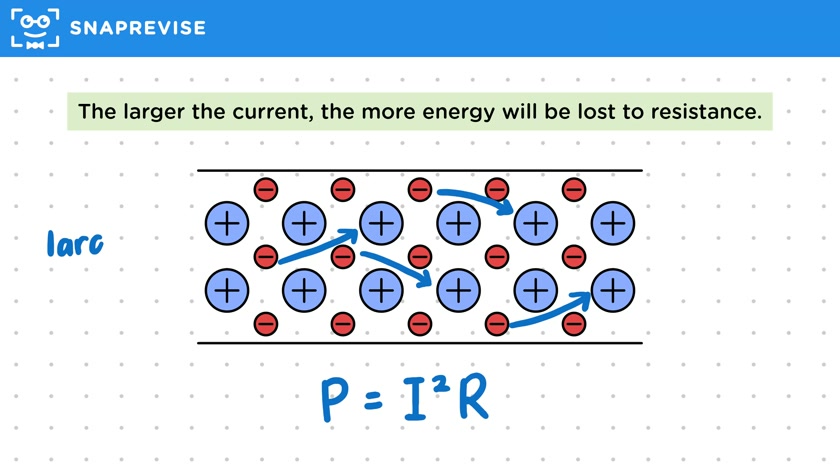
- Energy loss is due to collisions between charge carriers and ions in the conductor.
- Wires are made with low resistance to reduce heat loss, but resistance cannot be entirely removed.
- Power output of a component is given by current multiplied by potential difference.
- Larger currents result in more energy lost to resistance.
- Current is transported by delocalized electrons moving in the same direction through the wire.
- Power in terms of resistance is given by P = i��R.
- Larger currents cause faster electron movement, more collisions with ions, and more energy transfer, leading to more heat loss.
- Understanding higher currents causing larger power losses is not required in detail for exams, but applying power losses to the equation is necessary.
- Large energy losses occur when transporting electricity from power stations to homes due to long distances and low resistance wires.
- The national grid uses transformers to transport electricity at as low a current as possible.
- Transformers change the potential difference and current of an alternating current.
- Electricity is transported at a large potential difference and small current to reduce energy losses, as lower current means less energy loss to resistance.
Please subscribe to access these revision notes.
This, and all other video notes, are included in our premium subscriptions.
Premium accounts get access to all videos and revision notes.
Report an Issue
Spotted something wrong? Let us know and we'll take a look.