
GCSE Physics (AQA)
346 videos | 23 hours
Please subscribe to watch this video.
This, and all other videos, are included in our premium subscriptions.
Premium accounts get access to all videos.
Enable autoplay to keep watching
Your browser is blocking videos from playing automatically. To turn it back on:
Safari (Mac): Click the Safari menu item in the top bar, then Settings → Websites → Auto-Play, then set Auto-Play to Allow All Auto-Play for the current website.
Safari (iPhone/iPad): open the Settings app, then Apps → Safari → Auto-Play, and select Allow All Auto-Play.
Particle model of matter
Particle model and pressure
Demonstrating Gas Pressure
2:20
Gas Pressure and Kinetic Theory
Spec
4.3.3.1
- Gas pressure is demonstrated by heating a liquid in a sealed tin.
- Pressure from a gas is caused by collisions between particles and the walls of the container.
- The experiment is dangerous and should not be done at home.
- First step: pour a small amount of water into a tin and seal it with a close-fitting lid.
- The container should be made of metal or another strong material.
- Gas particles inside the tin exert the same outward force as the inward force exerted by particles outside the tin.
- There is an outward pressure on the tin due to collisions from air molecules inside and an inward pressure from air molecules outside.
- Overall, no effect is noticed from these pressures as they are equal and opposite.
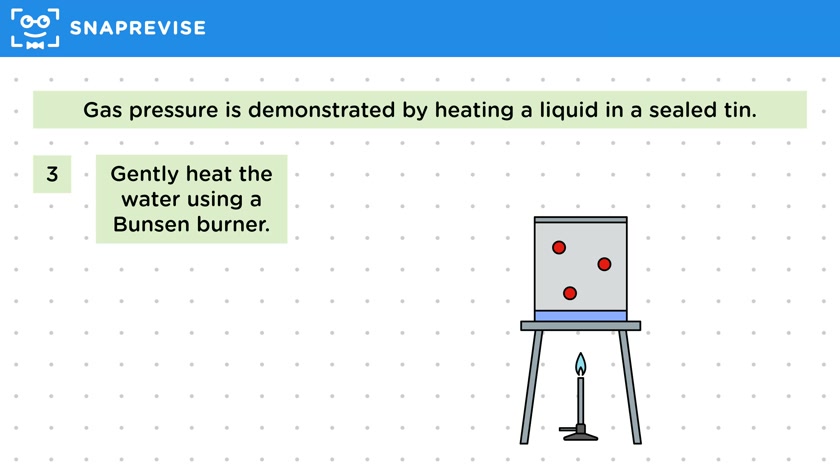
- Step three: gently heat the water using a bunsen burner.
- Thermal energy is transferred from the bunsen burner to the water and air inside the container, heating them.
- Water will evaporate and release more gas particles into the tin, reaching boiling point and turning to steam.
- Gas particles move faster as their temperature increases, gaining kinetic energy from heat flow.
- Step six: outward pressure from the gas becomes greater than the inward pressure, causing the lid to fly off.
- The lid is the weakest part of the tin, resulting in it being pushed off by the outward force.
- It is important to wear eye protection and keep a distance when observing this experiment.
Please subscribe to access these revision notes.
This, and all other video notes, are included in our premium subscriptions.
Premium accounts get access to all videos and revision notes.
Report an Issue
Spotted something wrong? Let us know and we'll take a look.