
GCSE Physics (AQA)
346 videos | 23 hours
Please subscribe to watch this video.
This, and all other videos, are included in our premium subscriptions.
Premium accounts get access to all videos.
Enable autoplay to keep watching
Your browser is blocking videos from playing automatically. To turn it back on:
Safari (Mac): Click the Safari menu item in the top bar, then Settings → Websites → Auto-Play, then set Auto-Play to Allow All Auto-Play for the current website.
Safari (iPhone/iPad): open the Settings app, then Apps → Safari → Auto-Play, and select Allow All Auto-Play.
Atomic structure
Hazards and uses of radioactive emissions and of background radiation
Choosing Radioactive Tracers
3:13
Radiation in Medicine
Spec
4.4.3.3
- Isotopes for radioactive tracers must be chosen carefully to avoid harming patients.
- Radioactive tracers are used to investigate organs internally, with careful consideration of dosage to minimize cancer risk.
- Radiation must be strong enough to detect for organ mapping, but not too weak to be ineffective.
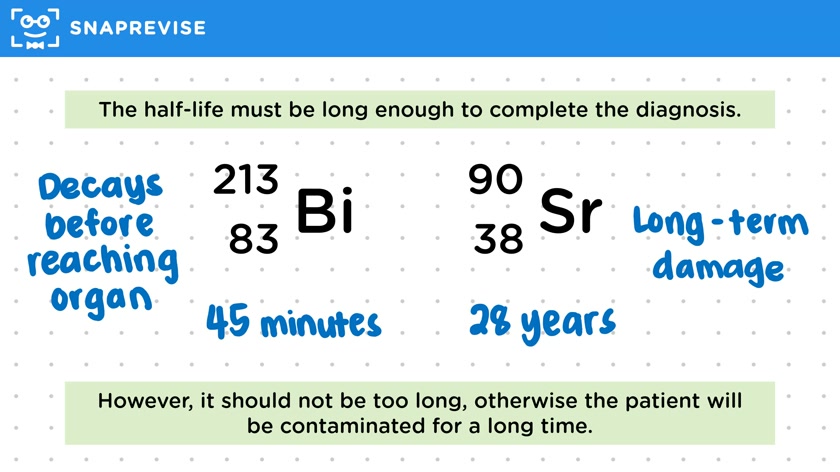
- The half-life of a tracer must be long enough for diagnosis but not too long to avoid prolonged contamination.
- Bismuth 83 has a short half-life (45 minutes) and is unsuitable as it decays before reaching the organ.
- Strontium 90 has a long half-life (28 years) and is unsuitable due to long-term decay inside the body.
- Beta or gamma emitters are preferred as they can escape the body, unlike alpha radiation which is stopped by tissue and skin.
- Alpha radiation is highly ionizing and dangerous inside the body, while beta and gamma are less ionizing and spread out.
- Technetium 99 is a commonly used tracer with a half-life of six hours, ideal for reaching organs without long-term contamination.
- Technetium 99 emits gamma radiation, which can easily leave the body and cause minimal damage.
- Understanding the properties of isotopes is important for determining their suitability as tracers in exams.
Please subscribe to access these revision notes.
This, and all other video notes, are included in our premium subscriptions.
Premium accounts get access to all videos and revision notes.
Report an Issue
Spotted something wrong? Let us know and we'll take a look.