
GCSE Physics (AQA)
346 videos | 23 hours
Please subscribe to watch this video.
This, and all other videos, are included in our premium subscriptions.
Premium accounts get access to all videos.
Enable autoplay to keep watching
Your browser is blocking videos from playing automatically. To turn it back on:
Safari (Mac): Click the Safari menu item in the top bar, then Settings → Websites → Auto-Play, then set Auto-Play to Allow All Auto-Play for the current website.
Safari (iPhone/iPad): open the Settings app, then Apps → Safari → Auto-Play, and select Allow All Auto-Play.
Waves
Electromagnetic waves
Calculating Magnification
5:54
Types of Image
Spec
4.6.2.5
- Magnification of an image can be calculated using the height of the object and the image on a ray diagram.
- A ray diagram helps determine where and how an image is formed by a lens.
- A converging convex lens is represented by a specific symbol.
- The principle axis and focuses are drawn to show where rays parallel to the axis will converge.
- Light rays from the top of the object refract through the lens and converge at the top of the formed image.
- Magnification is calculated using the formula: Magnification = Image Height / Object Height.
- Image and object heights can be measured directly from the diagram.
- Units for image and object height should be in distance units like centimeters or meters.
- Magnification is a ratio and has no units.
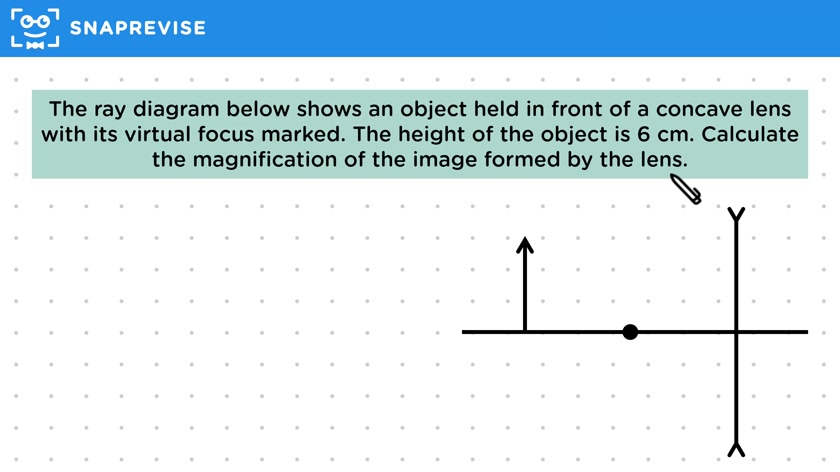
- Example problem: Calculate magnification using a ray diagram with a concave lens.
- Steps to solve the example:
- 1. Draw a ray through the center of the lens.
- 2. Draw a ray to the lens and through the virtual focus.
- 3. Draw the image where the rays converge.
- 4. Measure the height of the image.
- 5. Substitute values into the formula to calculate magnification.
- Example calculation: Object height is 6 cm, image height is 2 cm, magnification = 2/6 = 0.33.
- In exams, a range of acceptable answers is allowed due to measurement from a drawn diagram.
Please subscribe to access these revision notes.
This, and all other video notes, are included in our premium subscriptions.
Premium accounts get access to all videos and revision notes.
Report an Issue
Spotted something wrong? Let us know and we'll take a look.