
GCSE Physics (AQA)
346 videos | 23 hours
Please subscribe to watch this video.
This, and all other videos, are included in our premium subscriptions.
Premium accounts get access to all videos.
Enable autoplay to keep watching
Your browser is blocking videos from playing automatically. To turn it back on:
Safari (Mac): Click the Safari menu item in the top bar, then Settings → Websites → Auto-Play, then set Auto-Play to Allow All Auto-Play for the current website.
Safari (iPhone/iPad): open the Settings app, then Apps → Safari → Auto-Play, and select Allow All Auto-Play.
Forces
Forces and motion
Calculating Acceleration
3:36
Acceleration
Spec
4.5.6.1.5
- Acceleration measures how much velocity changes over time.
- Acceleration can describe changes in speed, a scalar quantity.
- The equation for acceleration: Acceleration = Change in velocity / Time taken.
- Change in velocity is calculated by subtracting starting velocity from final velocity.
- Negative accelerations indicate decreases in velocity.
- Symbolically, acceleration is represented as A = ��V / T, where ��V is the change in velocity.
- The same equation can be used to find average acceleration if acceleration is changing.
- Common units: Time in seconds, change in velocity in meters per second, acceleration in meters per second squared.
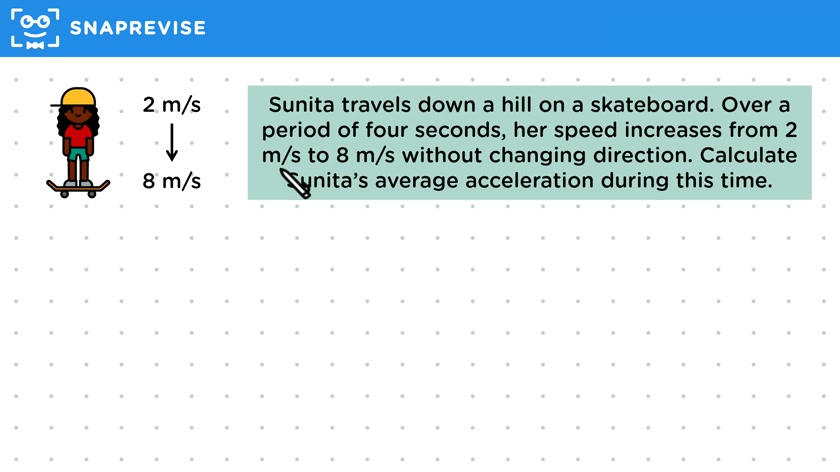
- Example problem: Sunita's speed increases from 2 m/s to 8 m/s over 4 seconds.
- Steps to solve:
- 1. Write down key information and check units.
- 2. Calculate change in velocity: Final velocity - Starting velocity.
- 3. Substitute values into the equation to find average acceleration.
- Sunita's average acceleration is 1.5 meters per second squared.
Please subscribe to access these revision notes.
This, and all other video notes, are included in our premium subscriptions.
Premium accounts get access to all videos and revision notes.
Report an Issue
Spotted something wrong? Let us know and we'll take a look.