
GCSE Combined Science (AQA)
622 videos | 38 hours
Please subscribe to watch this video.
This, and all other videos, are included in our premium subscriptions.
Premium accounts get access to all videos.
Enable autoplay to keep watching
Your browser is blocking videos from playing automatically. To turn it back on:
Safari (Mac): Click the Safari menu item in the top bar, then Settings → Websites → Auto-Play, then set Auto-Play to Allow All Auto-Play for the current website.
Safari (iPhone/iPad): open the Settings app, then Apps → Safari → Auto-Play, and select Allow All Auto-Play.
Waves
Waves in air, fluids and solids
Wave Speed
7:12
Wave Speed
Spec
4.6.1.2
- Wave speed is the speed at which energy is transferred by the wave.
- Matter vibrates to transport energy without moving overall.
- Wave speed differs from frequency; frequency indicates how quickly waves are produced, not how they carry energy.
- Wave speed can be visualized as the speed at which a point on the wave travels.
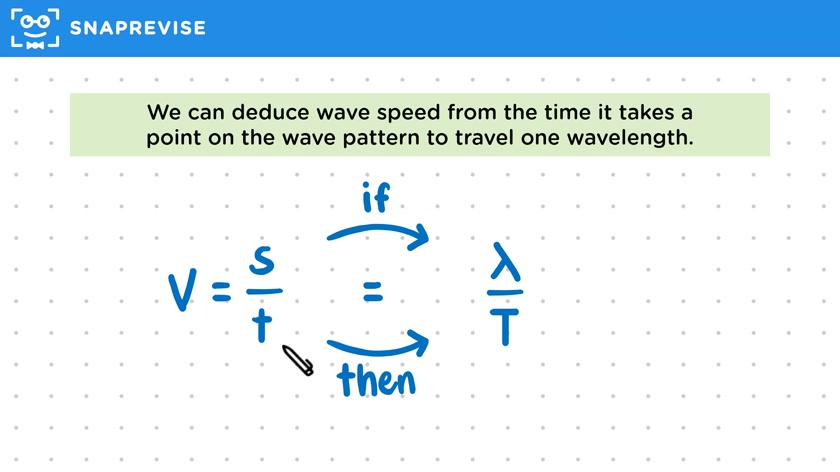
- Wave speed can be calculated from the time it takes a point on the wave to travel one wavelength.
- Wavelength is the distance after which the wave pattern repeats.
- The period of a wave is the time it takes for the wave to repeat its cycle of motion.
- Speed equation: speed = distance/time (V = S/T).
- For waves, speed = wavelength/period (V = ��/T).
- Frequency and period relation: F = 1/T.
- Wave speed equation: V = ��F (speed = wavelength x frequency).
- Units: wavelength in meters, frequency in hertz, speed in meters per second.
- Example problem: Calculate frequency given wave speed and wavelength.
- Rearrange wave speed equation to solve for frequency: frequency = wave speed/wavelength.
- Example calculation: frequency = 1.2 m/s divided by 0.3 m, resulting in 4 hertz.
Please subscribe to access these revision notes.
This, and all other video notes, are included in our premium subscriptions.
Premium accounts get access to all videos and revision notes.
Report an Issue
Spotted something wrong? Let us know and we'll take a look.