
GCSE Combined Science (AQA)
622 videos | 38 hours
Please subscribe to watch this video.
This, and all other videos, are included in our premium subscriptions.
Premium accounts get access to all videos.
Enable autoplay to keep watching
Your browser is blocking videos from playing automatically. To turn it back on:
Safari (Mac): Click the Safari menu item in the top bar, then Settings → Websites → Auto-Play, then set Auto-Play to Allow All Auto-Play for the current website.
Safari (iPhone/iPad): open the Settings app, then Apps → Safari → Auto-Play, and select Allow All Auto-Play.
Bioenergetics
Photosynthesis
Uses of Glucose from Photosynthesis
2:37
Photosynthesis Rate and Temperature
Spec
4.4.1.3
- Plants and algae produce glucose through photosynthesis.
- In photosynthesis, carbon dioxide reacts with water to create glucose and oxygen.
- Both plant and algal cells can photosynthesize.
- Glucose produced by photosynthesis is used for various purposes.
- Plant and algal cells use glucose for respiration, which is the opposite of photosynthesis.
- In respiration, glucose reacts with oxygen to produce carbon dioxide and water, and it transfers energy for cell processes.
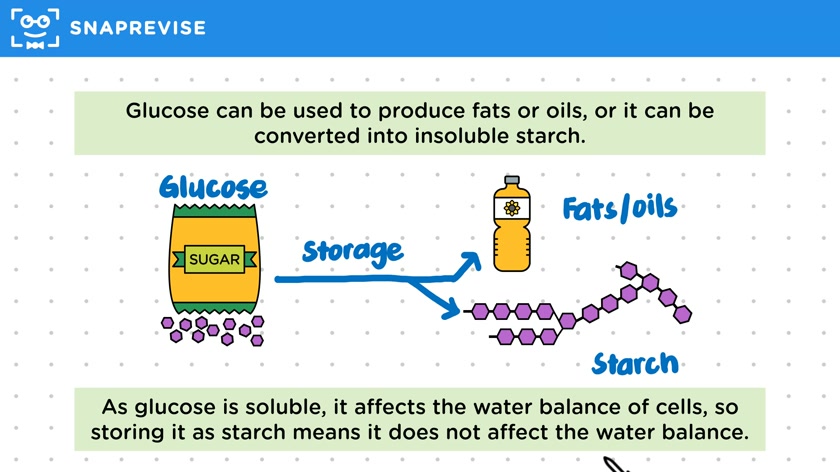
- Glucose can also be converted into fats, oils, or insoluble starch for storage.
- Storing glucose as starch prevents it from affecting the water balance of cells due to its insolubility.
- High concentrations of soluble glucose in cells can cause water to move in, potentially causing cells to swell or burst.
- Glucose is used to produce cellulose, which strengthens cell walls.
- Glucose is converted into the polymer cellulose, forming strong cell walls in plants and algae.
- Additionally, glucose is used to produce amino acids for protein synthesis.
- Plants use nitrate ions from the soil along with amino acids to synthesize proteins necessary for growth and repair.
Please subscribe to access these revision notes.
This, and all other video notes, are included in our premium subscriptions.
Premium accounts get access to all videos and revision notes.
Report an Issue
Spotted something wrong? Let us know and we'll take a look.