
GCSE Combined Science (AQA)
622 videos | 38 hours
Please subscribe to watch this video.
This, and all other videos, are included in our premium subscriptions.
Premium accounts get access to all videos.
Enable autoplay to keep watching
Your browser is blocking videos from playing automatically. To turn it back on:
Safari (Mac): Click the Safari menu item in the top bar, then Settings → Websites → Auto-Play, then set Auto-Play to Allow All Auto-Play for the current website.
Safari (iPhone/iPad): open the Settings app, then Apps → Safari → Auto-Play, and select Allow All Auto-Play.
Electricity
Energy transfers
Transformer Equation in the National Grid
3:23
The National Grid
Spec
4.2.4.3
- Transformers in the national grid are designed for maximum efficiency.
- Efficiency is achieved using low resistance wires and an insulating soft iron core.
- Electrical power input to a transformer is assumed to be equal to the power output.
- No energy is lost if power in equals power out.
- Power is calculated as potential difference multiplied by current.
- The equation for transformers is: VP * IP = VS * IS.
- VP and IP are the primary coil's potential difference and current.
- VS and IS are the secondary coil's potential difference and current.
- Units for potential differences are volts, and for currents, amps.
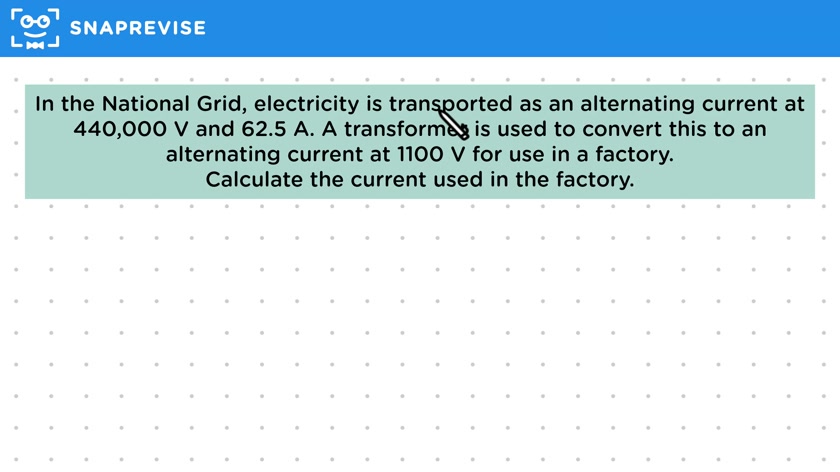
- Example: Electricity in the national grid is transported at 440,000 volts and 62.5 amps.
- A transformer converts this to 1,100 volts for factory use.
- To calculate the secondary current, rearrange the transformer equation.
- Secondary current = (Primary potential difference * Primary current) / Secondary potential difference.
- Calculation: (440,000 volts * 62.5 amps) / 1,100 volts = 25,000 amps used in the factory.
Please subscribe to access these revision notes.
This, and all other video notes, are included in our premium subscriptions.
Premium accounts get access to all videos and revision notes.
Report an Issue
Spotted something wrong? Let us know and we'll take a look.