
GCSE Combined Science (AQA)
622 videos | 38 hours
Please subscribe to watch this video.
This, and all other videos, are included in our premium subscriptions.
Premium accounts get access to all videos.
Enable autoplay to keep watching
Your browser is blocking videos from playing automatically. To turn it back on:
Safari (Mac): Click the Safari menu item in the top bar, then Settings → Websites → Auto-Play, then set Auto-Play to Allow All Auto-Play for the current website.
Safari (iPhone/iPad): open the Settings app, then Apps → Safari → Auto-Play, and select Allow All Auto-Play.
Infection and Response
Communicable Diseases
Salmonella
1:26
Diseases Caused by Bacteria, Fungi and Protists
Spec
4.3.1.3
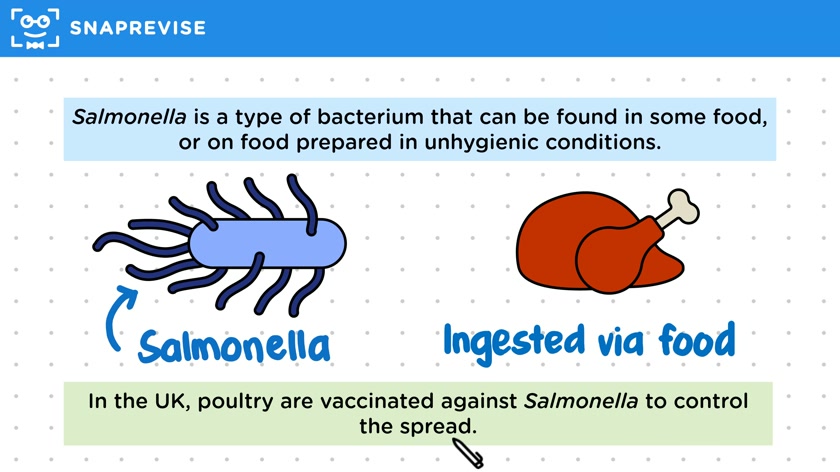
- Salmonella is a type of bacterium found in some foods or on food prepared in unhygienic conditions.
- Salmonella can be ingested through contaminated food.
- There are two species of salmonella bacteria, but specific identification is not necessary for general knowledge.
- Poultry, such as chicken, can be infected with salmonella, and unhygienic food preparation can transfer the bacteria to other foods.
- Undercooked foods like chicken and eggs are common ways salmonella spreads in the UK.
- Poultry in the UK are vaccinated against salmonella to control its spread.
- Salmonella bacteria cause food poisoning by secreting toxins.
- Symptoms of salmonella infection include fever, abdominal cramps, vomiting, and diarrhea.
- While salmonella infection is generally not life-threatening, it poses significant risks to infants, young children, people with weakened immune systems, and pregnant women.
- It is important to be aware of the symptoms and their causative agent, the toxins secreted by salmonella bacteria, for health and safety knowledge.
Please subscribe to access these revision notes.
This, and all other video notes, are included in our premium subscriptions.
Premium accounts get access to all videos and revision notes.
Report an Issue
Spotted something wrong? Let us know and we'll take a look.