
GCSE Combined Science (AQA)
622 videos | 38 hours
Please subscribe to watch this video.
This, and all other videos, are included in our premium subscriptions.
Premium accounts get access to all videos.
Enable autoplay to keep watching
Your browser is blocking videos from playing automatically. To turn it back on:
Safari (Mac): Click the Safari menu item in the top bar, then Settings → Websites → Auto-Play, then set Auto-Play to Allow All Auto-Play for the current website.
Safari (iPhone/iPad): open the Settings app, then Apps → Safari → Auto-Play, and select Allow All Auto-Play.
Energy
Energy changes in a system, and the ways energy is stored before and after such changes
Power
2:26
Energy Calculations
Spec
4.1.1.4
- Power is the rate at which energy is transferred or work is done.
- Work is a transfer of energy by a force, such as moving a box across a surface.
- The time taken for a process depends on the amount of power provided.
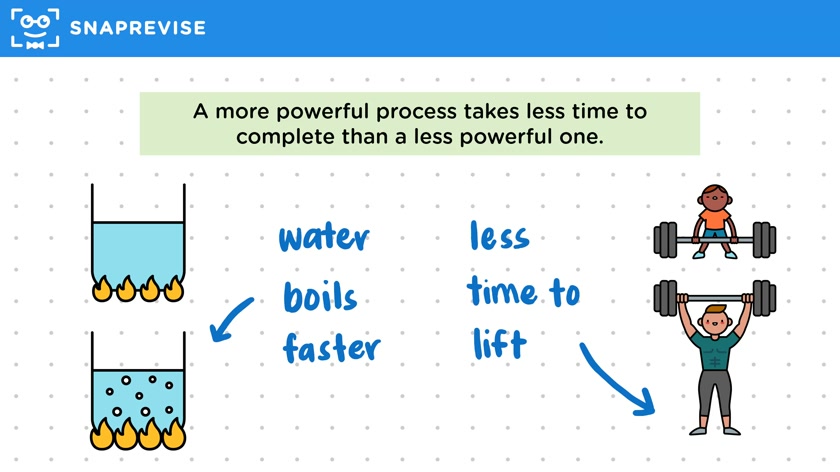
- A more powerful process takes less time to complete than a less powerful one.
- Example: A pot of water with a bigger flame boils faster, indicating more power.
- Example: A weightlifter with more powerful muscles can lift weights in less time.
- Electrical components have power ratings indicating the recommended rate of energy transfer.
- If electrical power is too low, the component won't work; if too high, it could be dangerous.
- The power of a motor determines how quickly an object accelerates and gains kinetic energy.
- A motor supplies kinetic energy to machines.
- Example: A mobility scooter has a low power engine, requiring low acceleration.
- Example: A train has a high power engine, often needing quick acceleration.
- Motors need to be powerful to oppose strong resistive forces, such as a train climbing a hill.
- Understanding simple examples can help describe differences in power and motor capabilities.
Please subscribe to access these revision notes.
This, and all other video notes, are included in our premium subscriptions.
Premium accounts get access to all videos and revision notes.
Report an Issue
Spotted something wrong? Let us know and we'll take a look.