
GCSE Combined Science (AQA)
622 videos | 38 hours
Please subscribe to watch this video.
This, and all other videos, are included in our premium subscriptions.
Premium accounts get access to all videos.
Enable autoplay to keep watching
Your browser is blocking videos from playing automatically. To turn it back on:
Safari (Mac): Click the Safari menu item in the top bar, then Settings → Websites → Auto-Play, then set Auto-Play to Allow All Auto-Play for the current website.
Safari (iPhone/iPad): open the Settings app, then Apps → Safari → Auto-Play, and select Allow All Auto-Play.
Infection and Response
Communicable Diseases
Pathogens
3:00
Pathogens and Infectious Diseases
Spec
4.3.1.1
- Pathogens are microorganisms that cause infectious diseases.
- Microorganisms are organisms visible under a microscope.
- Tissue samples are examined under a microscope to observe microorganisms.
- Infectious diseases are caused by organisms that can be transmitted.
- Pathogens include viruses, bacteria, protists, and fungi.
- The sizes of these pathogens are not to scale in diagrams, but relative to each other, with viruses being the smallest.
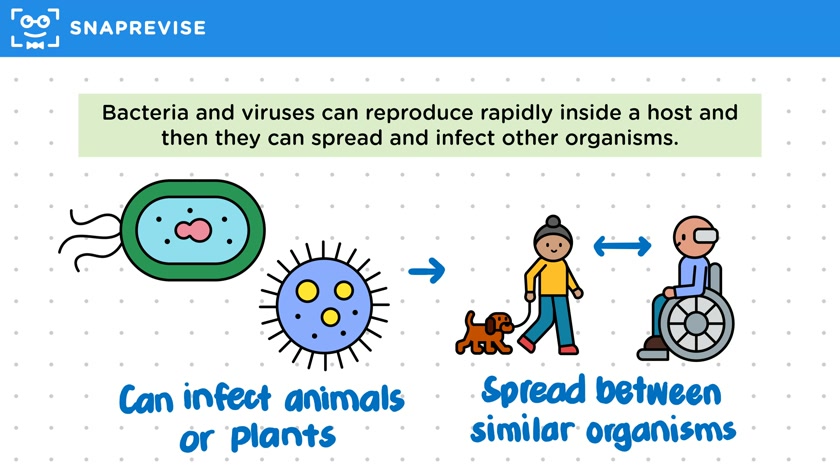
- Viruses and bacteria can reproduce rapidly inside a host, spreading to infect other organisms.
- Bacteria produce toxins that damage tissues and cause illness.
- Viruses enter cells, reproduce inside them, and cause cell damage, leading to illness.
- The process of viral infection involves the virus attaching to the host cell, injecting its genetic material, and tricking the cell into replicating the virus, which ultimately damages the cell and causes illness.
Please subscribe to access these revision notes.
This, and all other video notes, are included in our premium subscriptions.
Premium accounts get access to all videos and revision notes.
Report an Issue
Spotted something wrong? Let us know and we'll take a look.