
GCSE Combined Science (AQA)
622 videos | 38 hours
Please subscribe to watch this video.
This, and all other videos, are included in our premium subscriptions.
Premium accounts get access to all videos.
Enable autoplay to keep watching
Your browser is blocking videos from playing automatically. To turn it back on:
Safari (Mac): Click the Safari menu item in the top bar, then Settings → Websites → Auto-Play, then set Auto-Play to Allow All Auto-Play for the current website.
Safari (iPhone/iPad): open the Settings app, then Apps → Safari → Auto-Play, and select Allow All Auto-Play.
Bonding, structure, and the properties of matter
Chemical bonds, ionic, covalent and metallic
Naming Ionic Compounds
3:35
Ionic Compounds and Formulae
Spec
4.1.1.1
- Ionic compounds are formed from metals and non-metals.
- Table salt is an example of an ionic compound, composed of positive sodium ions and negative chloride ions, with the formula NaCl.
- Naming ionic compounds involves specific rules:
- If composed of two elements, the name ends in "ide."
- The metal's name remains unchanged, and "ide" replaces the non-metal's ending.
- Example: NaCl is named sodium chloride.
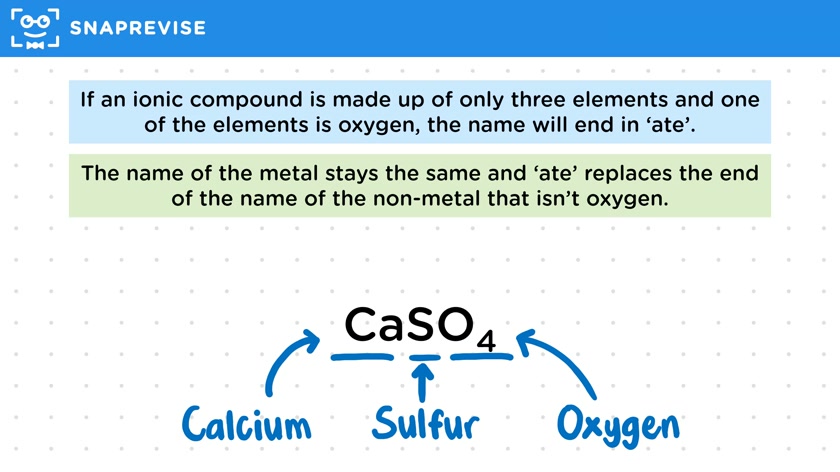
- For compounds with three elements, including oxygen, the name ends in "ate."
- Example: CaSO4 is named calcium sulfate.
- Example: Na2CO3 is named sodium carbonate.
- Compounds with a hydroxide ion (OH-) end in "hydroxide."
- Example: KOH is named potassium hydroxide.
- The metal's name remains unchanged in all cases.
- Recognizing the hydroxide ion is crucial for correct naming.
Please subscribe to access these revision notes.
This, and all other video notes, are included in our premium subscriptions.
Premium accounts get access to all videos and revision notes.
Report an Issue
Spotted something wrong? Let us know and we'll take a look.