
GCSE Combined Science (AQA)
622 videos | 38 hours
Please subscribe to watch this video.
This, and all other videos, are included in our premium subscriptions.
Premium accounts get access to all videos.
Enable autoplay to keep watching
Your browser is blocking videos from playing automatically. To turn it back on:
Safari (Mac): Click the Safari menu item in the top bar, then Settings → Websites → Auto-Play, then set Auto-Play to Allow All Auto-Play for the current website.
Safari (iPhone/iPad): open the Settings app, then Apps → Safari → Auto-Play, and select Allow All Auto-Play.
Bonding, structure, and the properties of matter
Chemical bonds, ionic, covalent and metallic
Metallic Bonding
2:52
Different types of Chemical Bonds
Spec
4.2.1.5
4.2.1.1
- Metallic bonding occurs in metallic elements.
- Examples of metals include copper, gold, and magnesium.
- Metals are located on the left-hand side of the periodic table.
- Metals are giant structures of atoms arranged in a regular pattern.
- Potassium is an example of a metal with a regular atomic pattern.
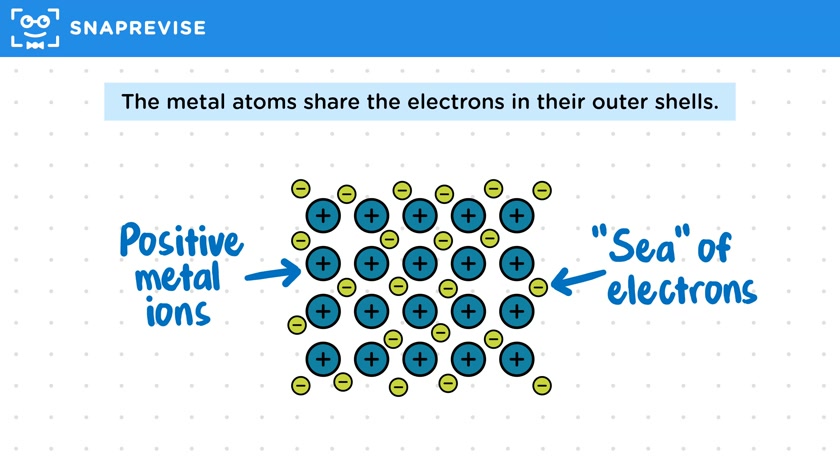
- Metal atoms share electrons in their outer shells with other metal atoms.
- This sharing creates a lattice of positive metal ions surrounded by a "sea of electrons."
- The electrons in the "sea" are delocalized and can move freely.
- Delocalized electrons are negatively charged and repel each other if too close.
- The sharing of delocalized electrons results in strong metallic bonds.
- Metallic bonds are strong electrostatic forces between delocalized electrons and positive ions.
- Metallic bonding is due to the attraction between positive metal ions and negative delocalized electrons.
- Metallic bonding can be represented using diagrams showing positive ions and delocalized electrons.
- Diagrams can depict delocalized electrons individually or as a collective "sea."
Please subscribe to access these revision notes.
This, and all other video notes, are included in our premium subscriptions.
Premium accounts get access to all videos and revision notes.
Report an Issue
Spotted something wrong? Let us know and we'll take a look.