
GCSE Combined Science (AQA)
622 videos | 38 hours
Please subscribe to watch this video.
This, and all other videos, are included in our premium subscriptions.
Premium accounts get access to all videos.
Enable autoplay to keep watching
Your browser is blocking videos from playing automatically. To turn it back on:
Safari (Mac): Click the Safari menu item in the top bar, then Settings → Websites → Auto-Play, then set Auto-Play to Allow All Auto-Play for the current website.
Safari (iPhone/iPad): open the Settings app, then Apps → Safari → Auto-Play, and select Allow All Auto-Play.
Homeostasis and Response
Hormonal Coordination in Humans
In Vitro Fertilisation (IVF)
2:39
Hormones Treating Infertility
Spec
4.5.3.6
- In vitro fertilization (IVF) involves combining an egg with sperm in a laboratory.
- The term "vitro" is Latin for glass, referring to the laboratory glassware used.
- IVF steps:
- Administering follicle stimulating hormone (FSH) and luteinizing hormone (LH) to stimulate egg maturation.
- Collecting mature eggs from the mother using a long needle.
- Fertilizing the eggs with sperm in the lab to form embryos.
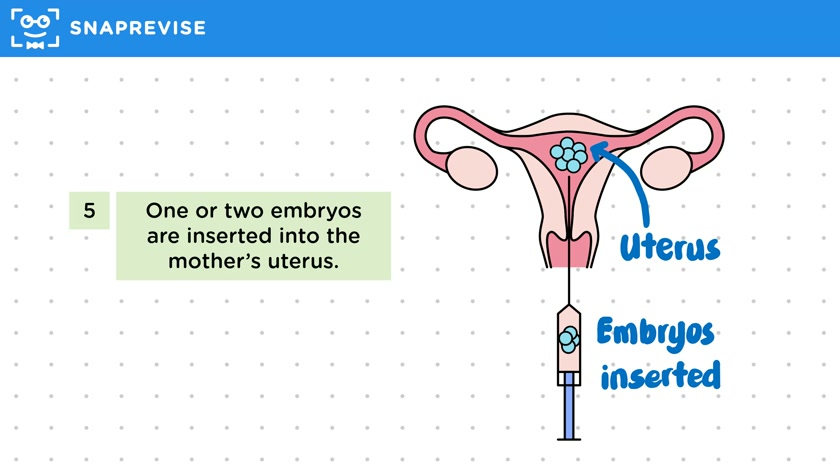
- Inserting one or two embryos into the mother's uterus using a needle.
- The sperm used can be from the father or a sperm donor.
- Advances in microscopy have enhanced IVF by improving the ability to see and assess the health of cells.
- IVF enables various family formations, including surrogacy and reciprocal IVF, popular in female same-sex relationships where one partner donates an egg and the other carries the pregnancy.
Please subscribe to access these revision notes.
This, and all other video notes, are included in our premium subscriptions.
Premium accounts get access to all videos and revision notes.
Report an Issue
Spotted something wrong? Let us know and we'll take a look.