
GCSE Combined Science (AQA)
622 videos | 38 hours
Please subscribe to watch this video.
This, and all other videos, are included in our premium subscriptions.
Premium accounts get access to all videos.
Enable autoplay to keep watching
Your browser is blocking videos from playing automatically. To turn it back on:
Safari (Mac): Click the Safari menu item in the top bar, then Settings → Websites → Auto-Play, then set Auto-Play to Allow All Auto-Play for the current website.
Safari (iPhone/iPad): open the Settings app, then Apps → Safari → Auto-Play, and select Allow All Auto-Play.
Atomic structure and the periodic table
The periodic table
Group 1: Reaction with Chlorine
3:33
Reactions of Group 1 elements
Spec
4.1.2.5
4.1.2.1
- Alkali metals react vigorously with chlorine when heated to form metal chlorides.
- Alkali metals are soft, can be cut with a knife, and have a shiny inside and dull outside.
- Chlorine gas is green at room temperature.
- Heating alkali metals and chlorine forms a white solid known as metal chloride, also called salts.
- Table salt is sodium chloride, one of many types of salts.
- Word equation: metal + chlorine reacts to form metal chloride.
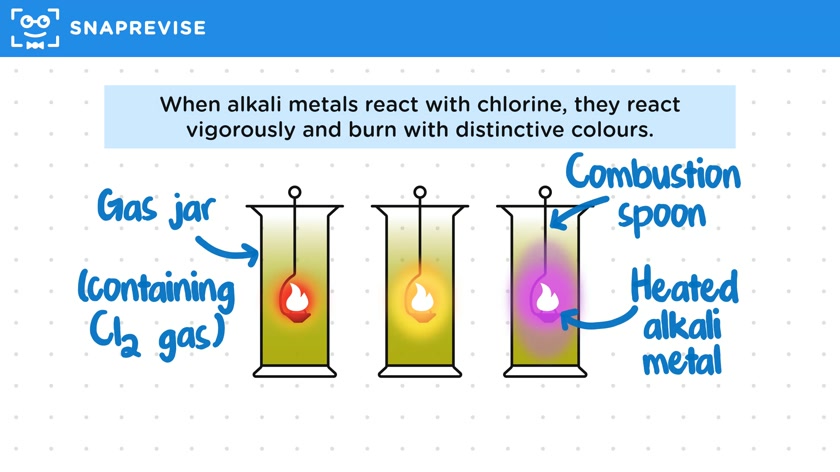
- Alkali metals burn with distinctive colors when reacting with chlorine.
- Three gas jars contain CL2 gas; alkali metals are lowered using combustion spoons.
- Metals are heated in a Bunsen flame before being plunged into chlorine jars.
- Reactions produce characteristic red, orange, and lilac flames.
- In exams, describe reactions of lithium, sodium, and potassium with chlorine.
- Lithium burns with a red flame, forming lithium chloride.
- Symbol equation: 2Li solid + Cl2 gas ��� 2LiCl solid.
- Sodium burns with an orange flame, forming sodium chloride.
- Symbol equation: 2Na solid + Cl2 gas ��� 2NaCl solid.
- Potassium burns with a purple flame, forming potassium chloride.
- Symbol equation: 2K solid + Cl2 gas ��� 2KCl solid.
Please subscribe to access these revision notes.
This, and all other video notes, are included in our premium subscriptions.
Premium accounts get access to all videos and revision notes.
Report an Issue
Spotted something wrong? Let us know and we'll take a look.