
GCSE Combined Science (AQA)
622 videos | 38 hours
Please subscribe to watch this video.
This, and all other videos, are included in our premium subscriptions.
Premium accounts get access to all videos.
Enable autoplay to keep watching
Your browser is blocking videos from playing automatically. To turn it back on:
Safari (Mac): Click the Safari menu item in the top bar, then Settings → Websites → Auto-Play, then set Auto-Play to Allow All Auto-Play for the current website.
Safari (iPhone/iPad): open the Settings app, then Apps → Safari → Auto-Play, and select Allow All Auto-Play.
Energy
National and global energy resources
Geothermal Energy
2:36
More Renewable Energy Resources
Spec
4.1.3
- Large stores of thermal energy exist in rocks and fluids below Earth's crust.
- This energy is from Earth's creation and nuclear reactions in the core.
- Thermal energy is stored as hot molten rocks (magma) and other forms.
- Thermal energy is close to Earth's surface at certain locations.
- Found from shallow depths to several miles below Earth's surface, leading to thermal currents.
- Near-surface thermal currents result in geezers and hot springs.
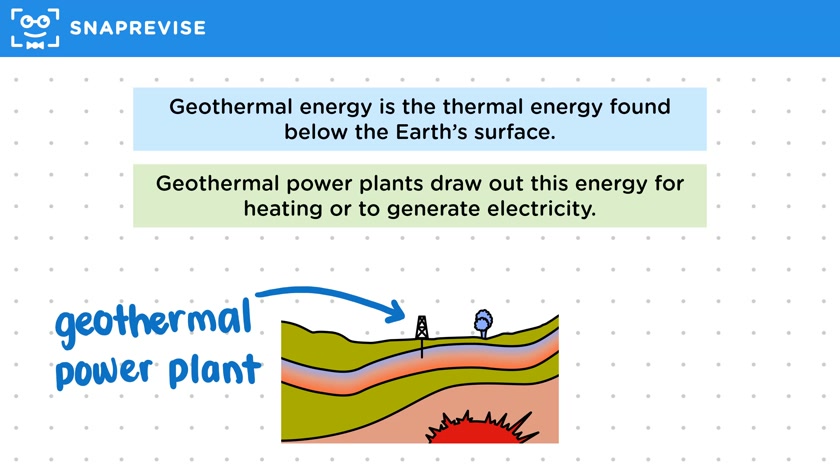
- Geothermal energy is thermal energy found below Earth's surface.
- Geothermal power plants use this energy for heating or electricity generation.
- Plants should be built near thermal currents, such as hot springs or geezers.
- Iceland has many suitable locations for geothermal energy generation.
- Thermal energy is harnessed by drilling into a thermal current.
- Water is pumped below the surface to be heated by thermal currents.
- Heated water can be used to heat homes or generate electricity.
- Advantages of geothermal energy: clean, renewable, no emissions, reliable.
- Disadvantages: few suitable locations, difficult and dangerous to set up.
Please subscribe to access these revision notes.
This, and all other video notes, are included in our premium subscriptions.
Premium accounts get access to all videos and revision notes.
Report an Issue
Spotted something wrong? Let us know and we'll take a look.