
GCSE Combined Science (AQA)
622 videos | 38 hours
Please subscribe to watch this video.
This, and all other videos, are included in our premium subscriptions.
Premium accounts get access to all videos.
Enable autoplay to keep watching
Your browser is blocking videos from playing automatically. To turn it back on:
Safari (Mac): Click the Safari menu item in the top bar, then Settings → Websites → Auto-Play, then set Auto-Play to Allow All Auto-Play for the current website.
Safari (iPhone/iPad): open the Settings app, then Apps → Safari → Auto-Play, and select Allow All Auto-Play.
Forces
Forces and their interactions
Free Body Diagrams
2:48
Resultant Force
Spec
4.5.1.4
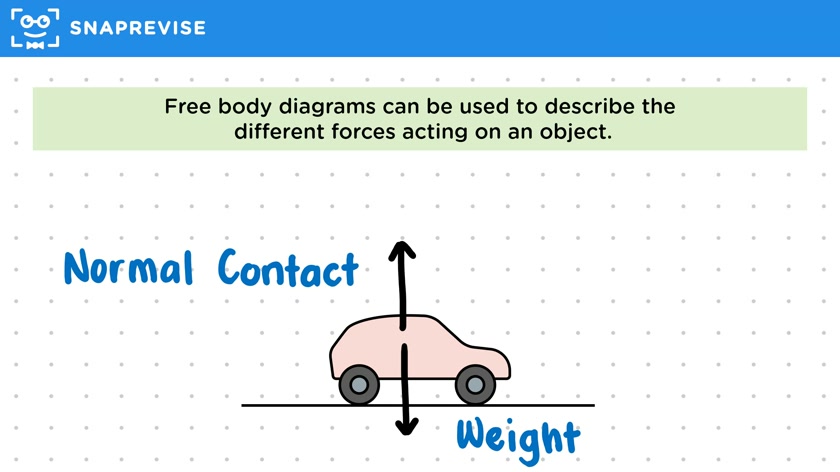
- A free body diagram shows the direction and magnitude of all forces acting on an object.
- Vectors, which have both magnitude and direction, can be represented as arrows in diagrams.
- Common forces in a free body diagram include weight, normal contact force, driving force, friction, and drag.
- Weight pulls the object downwards due to gravity.
- Normal contact force acts upwards, perpendicular to the surface, balancing the weight.
- Driving force propels the object forward, converting chemical energy to kinetic energy.
- Friction and drag act opposite to the direction of motion, resisting movement.
- Friction and drag result from collisions with air particles and surfaces sliding past each other.
- Forces can be labeled on a free body diagram, important for understanding in exams.
- The resultant force on an object can be determined using a free body diagram.
- Weight and normal contact forces cancel each other out, balancing vertically.
- The resultant force is to the right if the driving force is larger than the opposing friction.
Please subscribe to access these revision notes.
This, and all other video notes, are included in our premium subscriptions.
Premium accounts get access to all videos and revision notes.
Report an Issue
Spotted something wrong? Let us know and we'll take a look.