
GCSE Combined Science (AQA)
622 videos | 38 hours
Please subscribe to watch this video.
This, and all other videos, are included in our premium subscriptions.
Premium accounts get access to all videos.
Enable autoplay to keep watching
Your browser is blocking videos from playing automatically. To turn it back on:
Safari (Mac): Click the Safari menu item in the top bar, then Settings → Websites → Auto-Play, then set Auto-Play to Allow All Auto-Play for the current website.
Safari (iPhone/iPad): open the Settings app, then Apps → Safari → Auto-Play, and select Allow All Auto-Play.
Chemical changes
Reactivity of metals
Electrons: Oxidation & Reduction
6:57
Oxidation and Reduction of Metals
Spec
4.4.1.4
- Oxidation and reduction involve the gain and loss of oxygen in reactions.
- Example: Carbon extracts copper from copper oxide; copper loses oxygen (reduced), carbon gains oxygen (oxidized).
- This is a redox reaction (both oxidation and reduction occur).
- Oxidation and reduction can also be defined by electron transfer: oxidation is the loss of electrons, reduction is the gain of electrons.
- Species refer to atoms, molecules, and ions in chemistry.
- Acronym "OIL RIG" helps remember: Oxidation Is Loss, Reduction Is Gain.
- Example: Sodium losing an electron is oxidized; chlorine gaining an electron is reduced.
- In exams, identify oxidation and reduction by tracking electron transfer and using "OIL RIG".
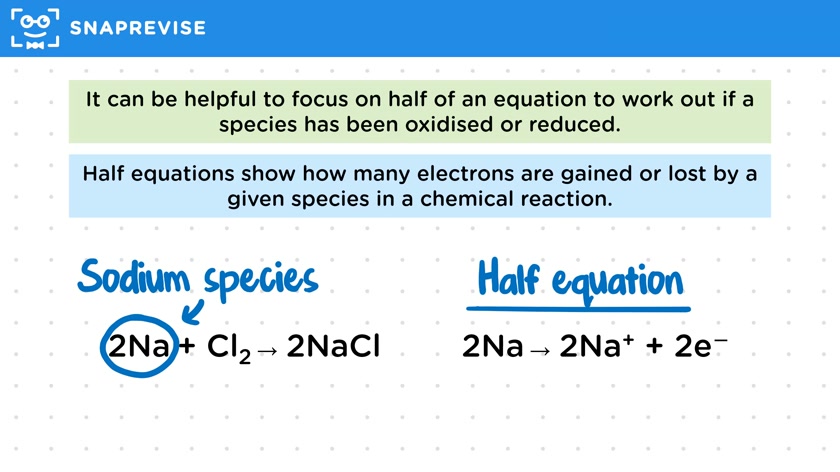
- Half equations can clarify oxidation and reduction by showing electron gain/loss for each species.
- Example: Sodium reacting with chlorine to form sodium chloride; sodium loses electrons (oxidized), chlorine gains electrons (reduced).
- Without half equations, deduce oxidation/reduction from balanced symbol equations and knowledge of ionic compounds.
- Example: Magnesium displacing copper from copper sulfate; magnesium loses electrons (oxidized), copper gains electrons (reduced).
Please subscribe to access these revision notes.
This, and all other video notes, are included in our premium subscriptions.
Premium accounts get access to all videos and revision notes.
Report an Issue
Spotted something wrong? Let us know and we'll take a look.