
GCSE Combined Science (AQA)
622 videos | 38 hours
Please subscribe to watch this video.
This, and all other videos, are included in our premium subscriptions.
Premium accounts get access to all videos.
Enable autoplay to keep watching
Your browser is blocking videos from playing automatically. To turn it back on:
Safari (Mac): Click the Safari menu item in the top bar, then Settings → Websites → Auto-Play, then set Auto-Play to Allow All Auto-Play for the current website.
Safari (iPhone/iPad): open the Settings app, then Apps → Safari → Auto-Play, and select Allow All Auto-Play.
Quantitative chemistry
Use of amount of substance in relation to masses of pure substances
Concentration of Solutions (g/dm3)
8:24
Calculating Concentration Using Mass and Volume
Spec
4.3.2.5
- Chemical reactions often occur in solutions.
- A solution is made by mixing a solvent (e.g., water) with a solute (e.g., table salt, sodium chloride).
- When mixed, the solute dissolves in the solvent, forming a solution.
- A solution with water as the solvent is called an aqueous solution.
- Concentration of a solution refers to how crowded particles are in a given volume of solvent.
- Greater number of particles in a given volume means greater concentration.
- Example: Two solutions with the same volume but different solute amounts have different concentrations.
- Concentration can be measured in mass per given volume of solution.
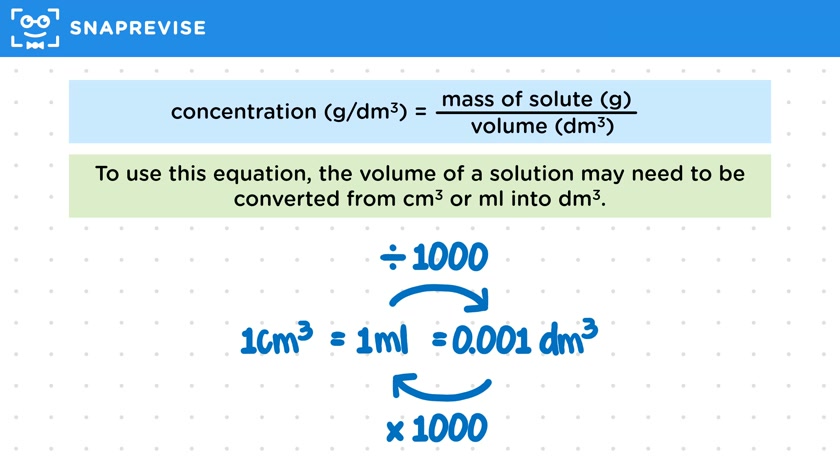
- Concentration equation: Concentration (g/dm��) = Mass of solute (g) / Volume of solution (dm��).
- Example calculation: A solution with 10 grams of solute in 0.2 dm�� has a concentration of 50 g/dm��.
- Volume conversion: 1 cm�� = 1 ml = 0.001 dm��.
- To convert cm�� or ml to dm��, divide by 1000; to convert dm�� to cm�� or ml, multiply by 1000.
- Mass of solute can be calculated if concentration and volume are known using: Mass = Concentration �� Volume.
- Example: A solution with a concentration of 20 g/dm�� and volume of 2 dm�� contains 40 grams of solute.
- Worked example: Calculate mass of magnesium hydroxide in a solution with given concentration and volume.
- Steps for calculation: Recall equation, rearrange for mass, substitute values, complete calculation, and add units.
- Example result: 4.0 grams of magnesium hydroxide in the solution.
Please subscribe to access these revision notes.
This, and all other video notes, are included in our premium subscriptions.
Premium accounts get access to all videos and revision notes.
Report an Issue
Spotted something wrong? Let us know and we'll take a look.