
GCSE Combined Science (AQA)
622 videos | 38 hours
Please subscribe to watch this video.
This, and all other videos, are included in our premium subscriptions.
Premium accounts get access to all videos.
Enable autoplay to keep watching
Your browser is blocking videos from playing automatically. To turn it back on:
Safari (Mac): Click the Safari menu item in the top bar, then Settings → Websites → Auto-Play, then set Auto-Play to Allow All Auto-Play for the current website.
Safari (iPhone/iPad): open the Settings app, then Apps → Safari → Auto-Play, and select Allow All Auto-Play.
The rate and extent of chemical change
Rate of reaction
Catalysts & Rate
5:38
Effects of Catalysts on the Rate of Reaction
Spec
4.6.1.2
4.6.1.4
- Chemical reactions can be accelerated using catalysts.
- Reaction rates can be plotted on graphs with time on the X-axis and product amount on the Y-axis.
- A catalyst increases the reaction rate, as shown by a steeper line on a graph.
- Catalysts are not consumed in a reaction.
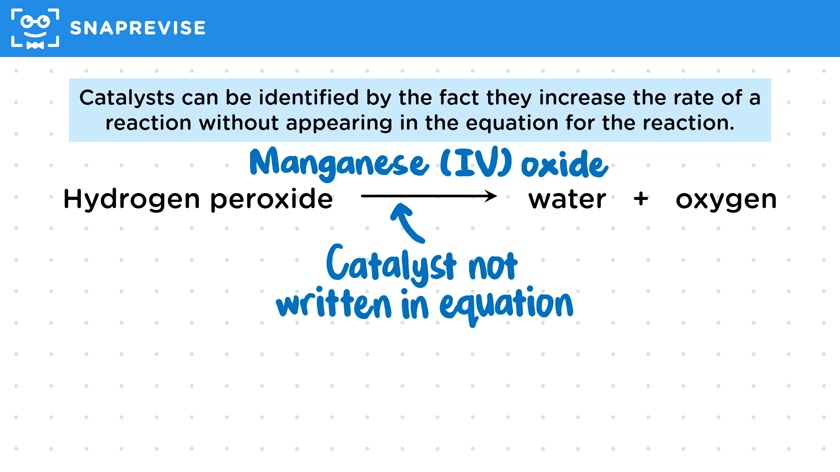
- Example: Manganese (IV) oxide speeds up the breakdown of hydrogen peroxide without being used up.
- Catalysts do not alter the products of a reaction.
- Catalysts increase reaction rates without appearing in the reaction equation.
- Different reactions require different catalysts.
- Platinum or palladium are used in catalytic converters in cars to convert harmful gases to cleaner exhaust gases.
- Nickel is used as a catalyst in margarine production to speed up the reaction of vegetable oils with hydrogen.
- Enzymes act as catalysts in biological systems, allowing reactions to occur at lower temperatures.
- Example: Amylase in saliva helps break down starch into sugars for energy.
- Enzymes are catalysts for biological reactions.
Please subscribe to access these revision notes.
This, and all other video notes, are included in our premium subscriptions.
Premium accounts get access to all videos and revision notes.
Report an Issue
Spotted something wrong? Let us know and we'll take a look.