
GCSE Combined Science (AQA)
622 videos | 38 hours
Please subscribe to watch this video.
This, and all other videos, are included in our premium subscriptions.
Premium accounts get access to all videos.
Enable autoplay to keep watching
Your browser is blocking videos from playing automatically. To turn it back on:
Safari (Mac): Click the Safari menu item in the top bar, then Settings → Websites → Auto-Play, then set Auto-Play to Allow All Auto-Play for the current website.
Safari (iPhone/iPad): open the Settings app, then Apps → Safari → Auto-Play, and select Allow All Auto-Play.
Energy changes
Exothermic and endothermic reactions
Activation Energy
3:00
Reaction Profiles
Spec
4.5.1.2
- Chemical reactions occur when reacting particles collide.
- Particles must collide with sufficient energy for a reaction to occur.
- Without sufficient energy, particles bounce off each other, and no reaction happens.
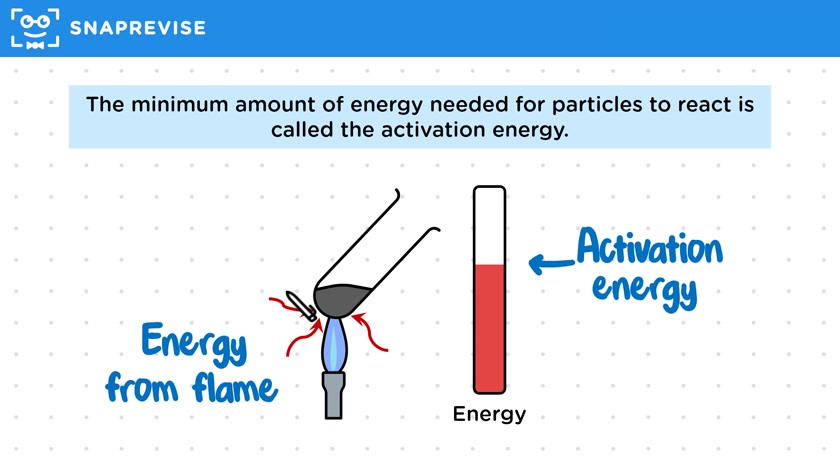
- The minimum energy needed for a reaction is called activation energy.
- Heating reactants can provide the necessary energy to reach activation energy.
- Reactions vary in activation energy; some occur at room temperature, others require additional energy.
- All reactions, including exothermic ones, have an activation energy.
- Exothermic reactions release energy to the surroundings but still require initial activation energy.
- A bunsen burner is an example where initial energy is needed to start a reaction, which then releases more energy.
Please subscribe to access these revision notes.
This, and all other video notes, are included in our premium subscriptions.
Premium accounts get access to all videos and revision notes.
Report an Issue
Spotted something wrong? Let us know and we'll take a look.