
GCSE Chemistry (AQA)
196 videos | 19 hours
Please subscribe to watch this video.
This, and all other videos, are included in our premium subscriptions.
Premium accounts get access to all videos.
Enable autoplay to keep watching
Your browser is blocking videos from playing automatically. To turn it back on:
Safari (Mac): Click the Safari menu item in the top bar, then Settings → Websites → Auto-Play, then set Auto-Play to Allow All Auto-Play for the current website.
Safari (iPhone/iPad): open the Settings app, then Apps → Safari → Auto-Play, and select Allow All Auto-Play.
Chemical changes
Reactivity of metals
The Reactivity Series
3:36
Metal Reactivity, Oxidation, and Extraction
Spec
4.4.1.2
- Metals react by forming positive ions.
- Metals give away their outer shell electrons to other atoms.
- Reactivity of a metal is related to its tendency to form positive ions.
- Sodium (Group 1) loses outer electrons more easily than magnesium (Group 2).
- Sodium is more reactive than magnesium.
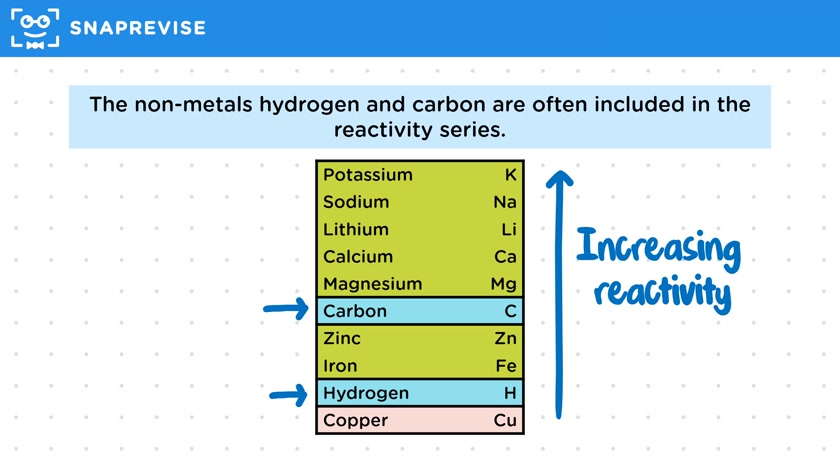
- Metals can be arranged in a reactivity series.
- Reactivity series is ordered by increasing reactivity.
- Copper is the least reactive, potassium is the most reactive.
- Hydrogen and carbon are included in the reactivity series.
- Non-metals are included for electrolysis and metal extraction processes.
- Metals are arranged based on reactions with water and dilute acids.
- More vigorous reactions indicate higher reactivity.
- Sodium reacts more vigorously with water than magnesium.
- Reactivity is linked to the ease of forming positive ions.
- Group 1 metals form positive ions more easily than Group 2 metals.
- Reactions with water and dilute acids help build the reactivity series.
Please subscribe to access these revision notes.
This, and all other video notes, are included in our premium subscriptions.
Premium accounts get access to all videos and revision notes.
Report an Issue
Spotted something wrong? Let us know and we'll take a look.