
GCSE Chemistry (AQA)
196 videos | 19 hours
Please subscribe to watch this video.
This, and all other videos, are included in our premium subscriptions.
Premium accounts get access to all videos.
Enable autoplay to keep watching
Your browser is blocking videos from playing automatically. To turn it back on:
Safari (Mac): Click the Safari menu item in the top bar, then Settings → Websites → Auto-Play, then set Auto-Play to Allow All Auto-Play for the current website.
Safari (iPhone/iPad): open the Settings app, then Apps → Safari → Auto-Play, and select Allow All Auto-Play.
Atomic structure and the periodic table
A simple model of the atom, symbols, relative atomic mass, electronic charge and isotopes
Simple Distillation
4:36
Separation of Mixtures
Spec
4.1.1.2
- Simple distillation is used to separate mixtures, specifically solvents from a solution.
- Distillation allows retention of the solvent, unlike crystallization which causes solvent loss.
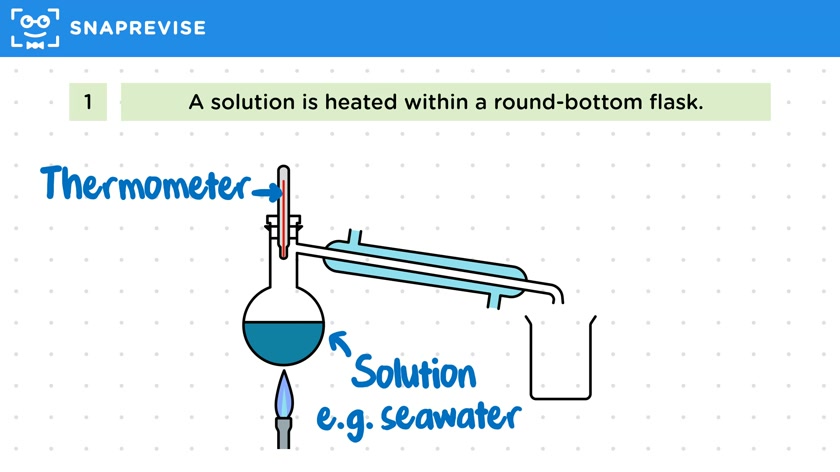
- Example setup: distillation of sea water, a mixture of water and dissolved salt.
- After distillation, pure water is collected separately, leaving salt in the flask.
- Simple distillation is a physical process, not involving chemical reactions or creating new substances.
- Process steps:
- 1. Heat the solution in a round bottom flask (e.g., sea water).
- 2. Solvent evaporates, forming vapor that rises in the flask.
- 3. Vapor passes through the inner tube of a condenser, cooled by cold water in the outer tube.
- 4. Vapor condenses back into liquid, collected in a vessel.
- 5. As water evaporates, salt crystals form in the flask.
- The process results in two products: pure water and salt crystals.
Please subscribe to access these revision notes.
This, and all other video notes, are included in our premium subscriptions.
Premium accounts get access to all videos and revision notes.
Report an Issue
Spotted something wrong? Let us know and we'll take a look.