
GCSE Chemistry (AQA)
196 videos | 19 hours
Please subscribe to watch this video.
This, and all other videos, are included in our premium subscriptions.
Premium accounts get access to all videos.
Enable autoplay to keep watching
Your browser is blocking videos from playing automatically. To turn it back on:
Safari (Mac): Click the Safari menu item in the top bar, then Settings → Websites → Auto-Play, then set Auto-Play to Allow All Auto-Play for the current website.
Safari (iPhone/iPad): open the Settings app, then Apps → Safari → Auto-Play, and select Allow All Auto-Play.
The rate and extent of chemical change
Rate of reaction
Reaction Profile for Catalysed Reaction
3:05
Effects of Catalysts on the Rate of Reaction
Spec
4.6.1.2
4.6.1.4
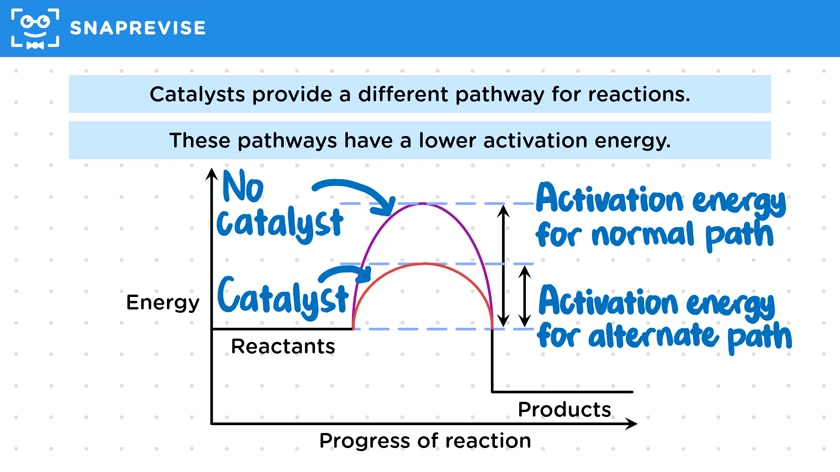
- Catalysts provide a different pathway for reactions with lower activation energy.
- Catalysts allow different reactions to occur, creating the same products as the direct reaction without a catalyst.
- Reaction profiles show how energy changes as a reaction progresses.
- Without a catalyst, reactants have more energy than products, and a bump represents the activation energy needed.
- With a catalyst, the energy levels of reactants and products remain unchanged, but the activation energy bump is lower.
- Lower activation energy means an alternate reaction path is provided by the catalyst.
- Catalysts are used in industry to lower activation energies, saving costs by reducing the need for high temperatures.
- Lowering activation energy increases the number of particles with sufficient energy to react.
- According to collision theory, reactions occur when particles collide with sufficient energy, which is the activation energy.
- Without a catalyst, many collisions occur, but few have enough energy to react.
- Adding a catalyst decreases the activation energy, allowing more collisions to lead to reactions.
- Catalysts increase the proportion of successful collisions, thus increasing the reaction rate.
- More successful collisions in the same amount of time result in a faster reaction and a higher rate.
Please subscribe to access these revision notes.
This, and all other video notes, are included in our premium subscriptions.
Premium accounts get access to all videos and revision notes.
Report an Issue
Spotted something wrong? Let us know and we'll take a look.