
GCSE Chemistry (AQA)
196 videos | 19 hours
Please subscribe to watch this video.
This, and all other videos, are included in our premium subscriptions.
Premium accounts get access to all videos.
Enable autoplay to keep watching
Your browser is blocking videos from playing automatically. To turn it back on:
Safari (Mac): Click the Safari menu item in the top bar, then Settings → Websites → Auto-Play, then set Auto-Play to Allow All Auto-Play for the current website.
Safari (iPhone/iPad): open the Settings app, then Apps → Safari → Auto-Play, and select Allow All Auto-Play.
The rate and extent of chemical change
Rate of reaction
Rate Calculations using Moles
4:26
Calculating Reaction Rates using Quantity and Time
Spec
4.6.1.1
- Mean rate of reaction can be calculated using the quantity of reactants in moles.
- Equation: Mean rate of reaction (moles/second) = Quantity of reactant used (moles) / Time taken for reaction (seconds).
- Example: Reaction of 0.1 moles of sodium thiosulfate with 0.1 moles of hydrochloric acid.
- Time for reaction to complete: 4 seconds.
- Calculation: 0.1 moles / 4 seconds = 0.025 moles per second.
- Units for rate of reaction when using moles: moles per second.
- Rate of reaction changes over time and can be tracked using graphs.
- Important to be comfortable with rate calculations using moles for exams.
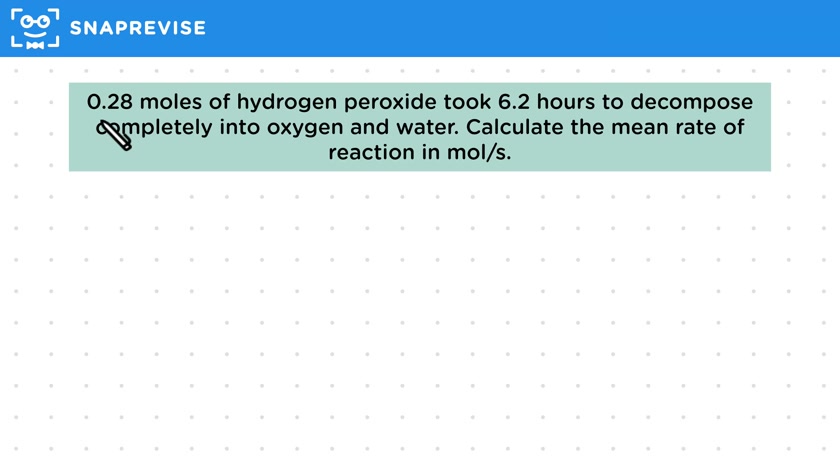
- Worked example: 0.28 moles of hydrogen peroxide decomposing in 6.2 hours.
- Convert time from hours to seconds: 6.2 hours = 21,600 seconds.
- Calculation: 0.28 moles / 21,600 seconds = 0.00001296 moles per second.
- Round to two significant figures: 0.000013 moles per second.
Please subscribe to access these revision notes.
This, and all other video notes, are included in our premium subscriptions.
Premium accounts get access to all videos and revision notes.
Report an Issue
Spotted something wrong? Let us know and we'll take a look.