
GCSE Chemistry (AQA)
196 videos | 19 hours
Please subscribe to watch this video.
This, and all other videos, are included in our premium subscriptions.
Premium accounts get access to all videos.
Enable autoplay to keep watching
Your browser is blocking videos from playing automatically. To turn it back on:
Safari (Mac): Click the Safari menu item in the top bar, then Settings → Websites → Auto-Play, then set Auto-Play to Allow All Auto-Play for the current website.
Safari (iPhone/iPad): open the Settings app, then Apps → Safari → Auto-Play, and select Allow All Auto-Play.
Using resources
The Haber process and the use of NPK fertilisers
NPK Fertilisers
4:31
Manufacture and Use of NPK fertilisers
Spec
4.10.4.2
- Plants require nitrogen, phosphorus, and potassium for healthy growth.
- Two plants grown under different conditions: one with ample nutrients, the other nutrient-deprived.
- Nutrient-rich plant has strong growth; nutrient-deprived plant has weak stem and dying leaves.
- Plants absorb mineral ions containing essential nutrients from soil water through roots.
- Nutrients are found in nitrate ions, phosphate ions, and potassium ions.
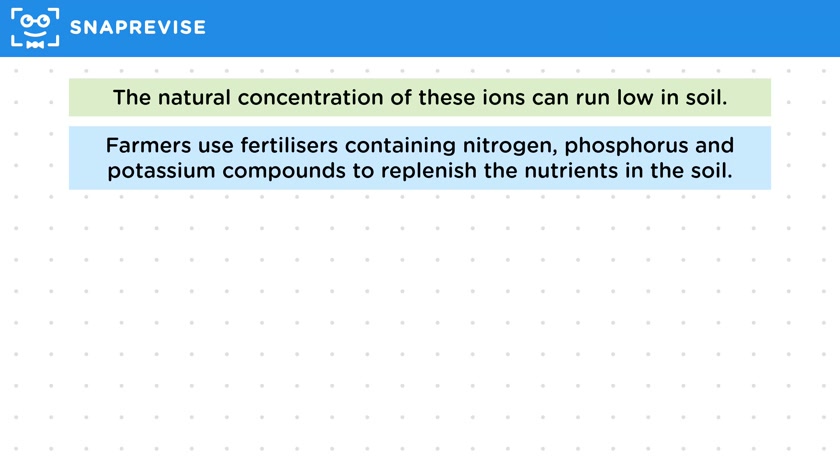
- Natural soil ion concentration can deplete as plants grow and are harvested.
- Farmers use fertilizers to replenish soil nutrients, which can be natural (compost, manure) or artificial.
- Fertilizers enhance agricultural productivity by ensuring sufficient nutrients for crops.
- NPK fertilizers contain compounds of nitrogen (N), phosphorus (P), and potassium (K).
- Fertilizers are formulated with specific ratios of elements based on plant needs.
- NPK fertilizers are made using soluble salts, which must dissolve in water for plant absorption.
- Soluble compounds for nitrogen include ammonium and nitrate ions; for phosphorus, phosphate ions; all common potassium compounds are soluble.
Please subscribe to access these revision notes.
This, and all other video notes, are included in our premium subscriptions.
Premium accounts get access to all videos and revision notes.
Report an Issue
Spotted something wrong? Let us know and we'll take a look.