
GCSE Chemistry (AQA)
196 videos | 19 hours
Please subscribe to watch this video.
This, and all other videos, are included in our premium subscriptions.
Premium accounts get access to all videos.
Enable autoplay to keep watching
Your browser is blocking videos from playing automatically. To turn it back on:
Safari (Mac): Click the Safari menu item in the top bar, then Settings → Websites → Auto-Play, then set Auto-Play to Allow All Auto-Play for the current website.
Safari (iPhone/iPad): open the Settings app, then Apps → Safari → Auto-Play, and select Allow All Auto-Play.
Chemical changes
Reactions of acids
Neutralisation and Naming Salts
14:54
pH and Neutralisation Reactions
Spec
4.4.2.2
- Acids react with alkalis to produce a salt and water.
- Example: Hydrochloric acid (HCl) reacts with sodium hydroxide (NaOH) to form sodium chloride (NaCl) and water (H2O).
- This reaction is called a neutralization reaction, resulting in a neutral salt solution.
- Neutralization can be expressed as an ionic equation: H+ (from acid) + OH- (from alkali) ��� H2O.
- Bases neutralize acids to form salt and water; examples include sodium hydroxide (soluble) and copper hydroxide (insoluble).
- Alkalis are bases that dissolve in water.
- Metal carbonates also neutralize acids, forming salt, water, and carbon dioxide.
- Example: Sodium carbonate (Na2CO3) neutralizes hydrochloric acid to form sodium chloride, water, and carbon dioxide.
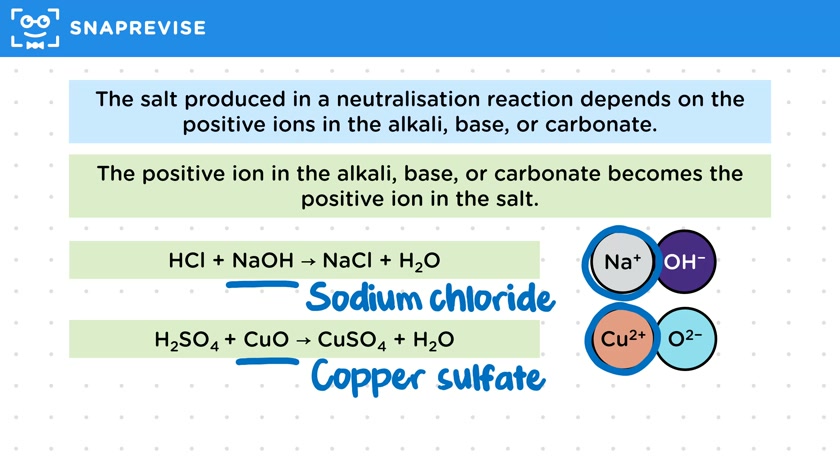
- The salt produced in neutralization depends on the acid and the positive ions in the alkali, base, or carbonate.
- Common acids and their salts: Hydrochloric acid (HCl) produces chloride salts, sulfuric acid (H2SO4) produces sulfate salts, and nitric acid (HNO3) produces nitrate salts.
- Predicting salt formation involves identifying the positive ion from the base or carbonate and the negative ion from the acid.
- Example reactions:
- HCl + NaOH ��� NaCl + H2O
- H2SO4 + CuO ��� CuSO4 + H2O
- 2HNO3 + CaCO3 ��� Ca(NO3)2 + CO2 + H2O
- Steps to complete and balance equations:
- 1. Identify reaction type and recall general equation.
- 2. Determine salt name from positive ion and acid used.
- 3. Use swap and drop method for salt formula.
- 4. Write products into the equation.
- 5. Balance the equation ensuring equal atoms on both sides.
- Practice writing and balancing equations with various acids, bases, and carbonates.
Please subscribe to access these revision notes.
This, and all other video notes, are included in our premium subscriptions.
Premium accounts get access to all videos and revision notes.
Report an Issue
Spotted something wrong? Let us know and we'll take a look.