
GCSE Chemistry (AQA)
196 videos | 19 hours
Please subscribe to watch this video.
This, and all other videos, are included in our premium subscriptions.
Premium accounts get access to all videos.
Enable autoplay to keep watching
Your browser is blocking videos from playing automatically. To turn it back on:
Safari (Mac): Click the Safari menu item in the top bar, then Settings → Websites → Auto-Play, then set Auto-Play to Allow All Auto-Play for the current website.
Safari (iPhone/iPad): open the Settings app, then Apps → Safari → Auto-Play, and select Allow All Auto-Play.
Using resources
Using materials
LD & HD Polymers, Thermosetting & Thermosoftening Polymers
10:53
Composition and Use of Different Materials
Spec
4.10.3.3
- Properties of polymers depend on the monomers used and the conditions of polymerization.
- Polymers are long chains of monomers, with various monomers available for polymer formation.
- Ethene and propane are examples of monomers with double bonds, affecting polymer properties.
- Polymerization conditions, such as temperature, influence polymer structure and properties.
- Polyethylene (PE) is a polymer made from ethene monomers.
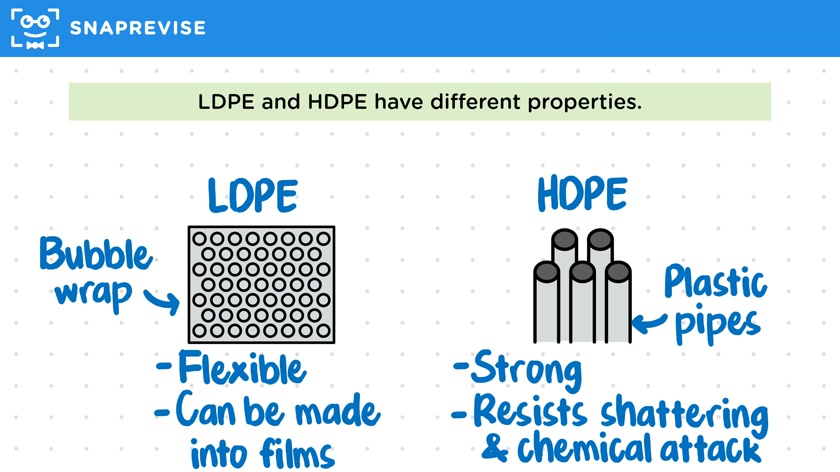
- Polyethylene can be low density (LDPE) or high density (HDPE) based on reaction conditions.
- LDPE has branched chains, resulting in lower density, while HDPE has less branching and higher density.
- LDPE is made at higher temperatures and pressures than HDPE, with different catalysts.
- LDPE is flexible and used for products like bubble wrap; HDPE is strong and used for pipes.
- Thermo softening polymers melt when heated, suitable for recyclable products like bottles.
- Thermo setting polymers do not melt when heated, suitable for high-temperature applications like kettles.
- Thermo softening polymers lack bonds between chains, allowing them to melt; thermo setting polymers have crosslinks, preventing melting.
- Thermo softening polymers can be recycled; thermo setting polymers are used where melting is undesirable.
- For exams, understanding the difference between thermo softening and thermo setting polymers is crucial.
- Example application: choosing a polymer for firefighter uniforms requires considering flame resistance, melting point, and density.
- Polymer Y, with desired properties, is suitable for firefighter uniforms.
Please subscribe to access these revision notes.
This, and all other video notes, are included in our premium subscriptions.
Premium accounts get access to all videos and revision notes.
Report an Issue
Spotted something wrong? Let us know and we'll take a look.