
GCSE Chemistry (AQA)
196 videos | 19 hours
Please subscribe to watch this video.
This, and all other videos, are included in our premium subscriptions.
Premium accounts get access to all videos.
Enable autoplay to keep watching
Your browser is blocking videos from playing automatically. To turn it back on:
Safari (Mac): Click the Safari menu item in the top bar, then Settings → Websites → Auto-Play, then set Auto-Play to Allow All Auto-Play for the current website.
Safari (iPhone/iPad): open the Settings app, then Apps → Safari → Auto-Play, and select Allow All Auto-Play.
Atomic structure and the periodic table
The periodic table
Group 7: Compounds
2:55
Group 7 Element Properties, Compounds, and Reactions
Spec
4.1.2.6
- Halogens form negative ions before forming compounds.
- Examples of halogen ions include chloride, bromide, and iodide ions.
- Halogens receive an electron to fill their outer shell, becoming negatively charged.
- Halogen names end in "een" (e.g., chlorine, bromine, iodine), but as ions, they end in "ide" (e.g., chloride, bromide, iodide).
- This naming convention is important for the compounds halogens form.
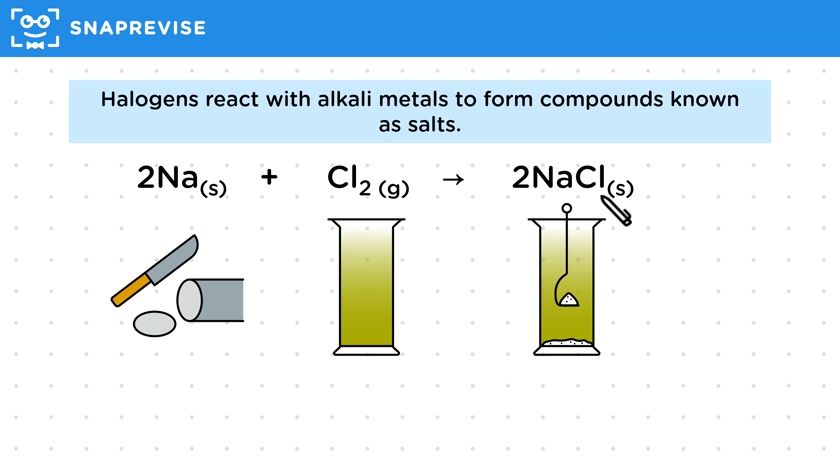
- Halogens react with alkaline metals to form salts.
- Example: Sodium reacts with chlorine to form sodium chloride (NaCl), a white solid salt.
- Salt names combine the metal name with the halogen ion name, using the "ide" ending.
- Sodium chloride is common table salt, but "salt" in chemistry refers to any alkali metal halogen compound.
- Halogens also form compounds with non-metals, such as hydrogen.
- Example: Hydrogen gas reacts with chlorine gas to form hydrogen chloride (HCl), a colorless gas.
- Naming follows the same rules, using the "ide" ending.
- For exams, predict and name products when halogens react with metals and non-metals, especially chlorine, bromine, or iodine.
Please subscribe to access these revision notes.
This, and all other video notes, are included in our premium subscriptions.
Premium accounts get access to all videos and revision notes.
Report an Issue
Spotted something wrong? Let us know and we'll take a look.