
GCSE Chemistry (AQA)
196 videos | 19 hours
Please subscribe to watch this video.
This, and all other videos, are included in our premium subscriptions.
Premium accounts get access to all videos.
Enable autoplay to keep watching
Your browser is blocking videos from playing automatically. To turn it back on:
Safari (Mac): Click the Safari menu item in the top bar, then Settings → Websites → Auto-Play, then set Auto-Play to Allow All Auto-Play for the current website.
Safari (iPhone/iPad): open the Settings app, then Apps → Safari → Auto-Play, and select Allow All Auto-Play.
The rate and extent of chemical change
Rate of reaction
Calculating Rate from Graphs
7:05
Calculating Reaction Rates using Graphs
Spec
4.6.1.1
- The rate of a reaction changes as the reaction progresses.
- Rate measures how quickly reactants are used up or products are made.
- A rate of reaction graph can measure the rate at a specific time.
- Example: Gas product collected in a syringe, timed with a stopwatch, and volume measured at regular intervals.
- Plot a graph with volume on the y-axis and time on the x-axis, resulting in a curve.
- Most gas is produced early, with the reaction slowing down towards the end.
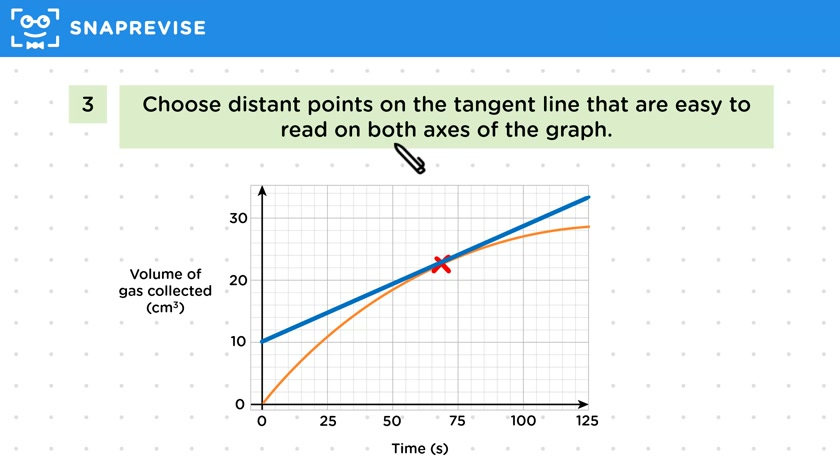
- The rate of reaction at a given time is the gradient of the curve at that point.
- Calculate the gradient of a graph to determine its steepness.
- For curved reaction graphs, calculate the gradient of the tangent to the curve.
- A tangent is a line that just touches the curve and has the same gradient at that point.
- The steeper the line, the bigger the gradient, indicating a faster reaction.
- Use gradients to calculate rates of reaction from graphs in exams.
- Steps to calculate gradient:
- 1. Identify a point in time and mark it on the graph.
- 2. Draw a tangent line using a ruler, ensuring it just touches the curve.
- 3. Choose distant points on the tangent line that are easy to read on both axes.
- 4. Calculate the change in the y-axis and x-axis between the points.
- 5. Use these changes to calculate the gradient.
- Gradient formula: Gradient = Change in Y / Change in X.
- Example calculation: Change in Y = 20, Change in X = 105, Gradient = 0.19.
- Rate of reaction is equal to the gradient.
- Determine units for the rate of reaction by dividing units of the y-axis by the x-axis.
- Example units: Centimeters cubed per second (cm��/s).
Please subscribe to access these revision notes.
This, and all other video notes, are included in our premium subscriptions.
Premium accounts get access to all videos and revision notes.
Report an Issue
Spotted something wrong? Let us know and we'll take a look.