
GCSE Chemistry (AQA)
196 videos | 19 hours
Please subscribe to watch this video.
This, and all other videos, are included in our premium subscriptions.
Premium accounts get access to all videos.
Enable autoplay to keep watching
Your browser is blocking videos from playing automatically. To turn it back on:
Safari (Mac): Click the Safari menu item in the top bar, then Settings → Websites → Auto-Play, then set Auto-Play to Allow All Auto-Play for the current website.
Safari (iPhone/iPad): open the Settings app, then Apps → Safari → Auto-Play, and select Allow All Auto-Play.
Quantitative chemistry
Yield and atom economy of chemical reactions
Atom Economy
8:08
Efficiency of Chemical Reactions
Spec
4.3.3.2
- Atom economy measures the amount of starting materials that become useful products.
- Important for planning reactions to minimize byproducts.
- Example: Reaction producing a useful solid and unnecessary liquid (water).
- Atom economy percentage calculated using the balanced equation.
- Formula: (Relative formula mass of desired product / Sum of relative formula masses of all reactants) x 100.
- Example calculation with ammonia and oxygen producing nitric acid and water.
- Nitric acid is the useful product; calculation shows 77.7% atom economy.
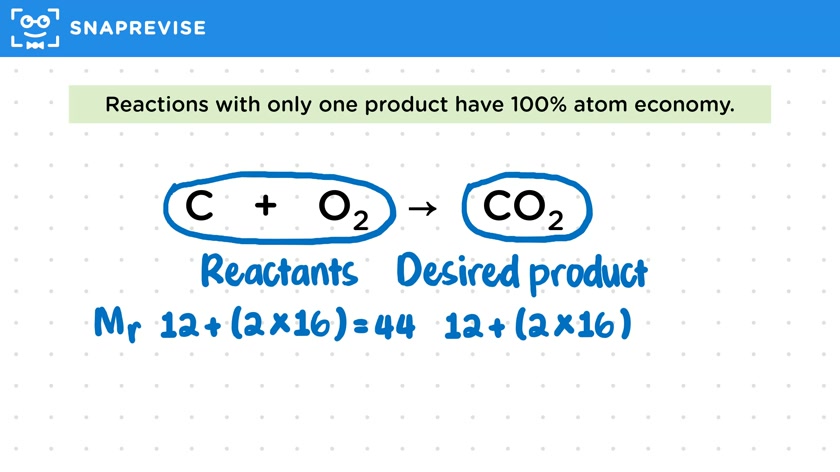
- Reactions with one product have 100% atom economy.
- Example: Carbon and oxygen making carbon dioxide.
- Law of conservation of mass ensures all atoms are used in a single product reaction.
- Practice example: Hydrogen production from coal and steam.
- Calculation shows 8.3% atom economy, indicating most reactants form CO2 byproduct.
- High atom economy is crucial for sustainability and cost-effectiveness.
- Low atom economy reactions use more raw materials and produce waste.
- High atom economy reactions are more efficient and preferable.
- Near 100% atom economy is ideal, minimizing waste and raw material use.
Please subscribe to access these revision notes.
This, and all other video notes, are included in our premium subscriptions.
Premium accounts get access to all videos and revision notes.
Report an Issue
Spotted something wrong? Let us know and we'll take a look.