
GCSE Biology (AQA)
331 videos | 14 hours
Please subscribe to watch this video.
This, and all other videos, are included in our premium subscriptions.
Premium accounts get access to all videos.
Enable autoplay to keep watching
Your browser is blocking videos from playing automatically. To turn it back on:
Safari (Mac): Click the Safari menu item in the top bar, then Settings → Websites → Auto-Play, then set Auto-Play to Allow All Auto-Play for the current website.
Safari (iPhone/iPad): open the Settings app, then Apps → Safari → Auto-Play, and select Allow All Auto-Play.
Bioenergetics
Photosynthesis
Temperature & Photosynthesis
2:09
Photosynthesis Rate and Temperature
Spec
4.4.1.2
- Temperature impacts all chemical reactions, including photosynthesis.
- Investigating the effect of temperature on photosynthesis can be done by counting oxygen bubbles released from pondweed at different temperatures.
- The rate of photosynthesis can be measured by counting the oxygen bubbles released per minute while varying the water temperature in a water bath.
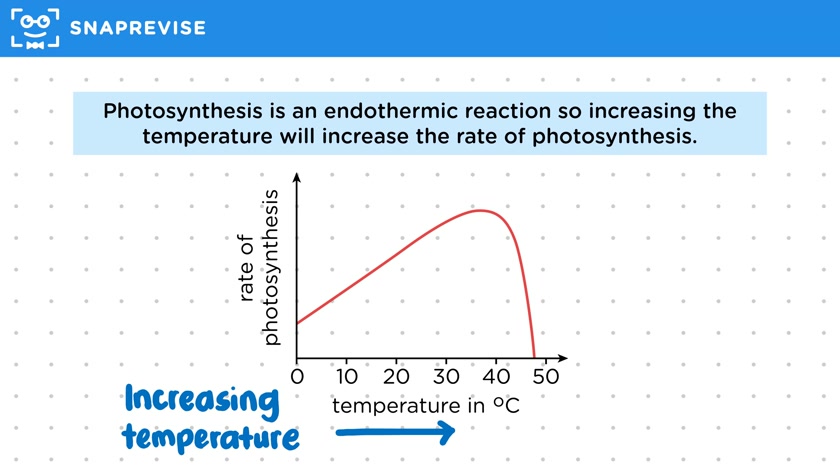
- Photosynthesis is an endothermic reaction, so increasing temperature generally increases the rate of photosynthesis.
- The relationship between temperature and photosynthesis rate can be represented graphically, showing an increase in rate up to around 40 degrees Celsius, after which the rate decreases.
- The decrease in photosynthesis rate at high temperatures is due to the denaturation of enzymes within the plant.
- Enzymes, which control photosynthesis, can become denatured (change shape and stop working) at high temperatures, preventing them from fitting with their substrate.
- Understanding the role of enzymes in photosynthesis and their behavior at different temperatures helps in interpreting graphs that show the rate of photosynthesis and temperature as a limiting factor.
Please subscribe to access these revision notes.
This, and all other video notes, are included in our premium subscriptions.
Premium accounts get access to all videos and revision notes.
Report an Issue
Spotted something wrong? Let us know and we'll take a look.