
GCSE Biology (AQA)
331 videos | 14 hours
Please subscribe to watch this video.
This, and all other videos, are included in our premium subscriptions.
Premium accounts get access to all videos.
Enable autoplay to keep watching
Your browser is blocking videos from playing automatically. To turn it back on:
Safari (Mac): Click the Safari menu item in the top bar, then Settings → Websites → Auto-Play, then set Auto-Play to Allow All Auto-Play for the current website.
Safari (iPhone/iPad): open the Settings app, then Apps → Safari → Auto-Play, and select Allow All Auto-Play.
Inheritance, Variation and Evolution
Reproduction
Sexual vs Asexual Reproduction
0:58
Comparing Sexual and Asexual Reproduction
Spec
4.6.1.3
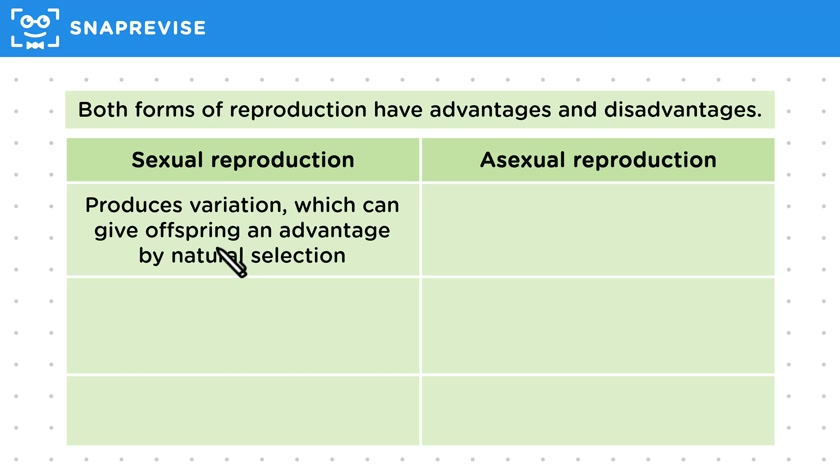
- Both forms of reproduction, sexual and asexual, have advantages and disadvantages.
- It's important to explain these advantages and disadvantages for any organism in exams.
- Typically, an advantage of one form of reproduction is a disadvantage of the other.
- Sexual reproduction produces variation, which can be advantageous through natural selection.
- Asexual reproduction does not produce variation.
- Sexual reproduction requires two parents and is slower because a mate needs to be found.
- Asexual reproduction requires only one parent, making it faster and more energy-efficient.
- Sexual reproduction results in a limited number of offspring over time.
- Asexual reproduction allows for the production of many identical offspring quickly.
Please subscribe to access these revision notes.
This, and all other video notes, are included in our premium subscriptions.
Premium accounts get access to all videos and revision notes.
Report an Issue
Spotted something wrong? Let us know and we'll take a look.