
GCSE Biology (AQA)
331 videos | 14 hours
Please subscribe to watch this video.
This, and all other videos, are included in our premium subscriptions.
Premium accounts get access to all videos.
Enable autoplay to keep watching
Your browser is blocking videos from playing automatically. To turn it back on:
Safari (Mac): Click the Safari menu item in the top bar, then Settings → Websites → Auto-Play, then set Auto-Play to Allow All Auto-Play for the current website.
Safari (iPhone/iPad): open the Settings app, then Apps → Safari → Auto-Play, and select Allow All Auto-Play.
Bioenergetics
Photosynthesis
Inverse Square Law & Light Intensity
1:51
Photosynthesis and Light Intensity, Carbon Dioxide and Chlorophyll
Spec
4.4.1.2
- As the distance between a plant and light increases, the light intensity decreases.
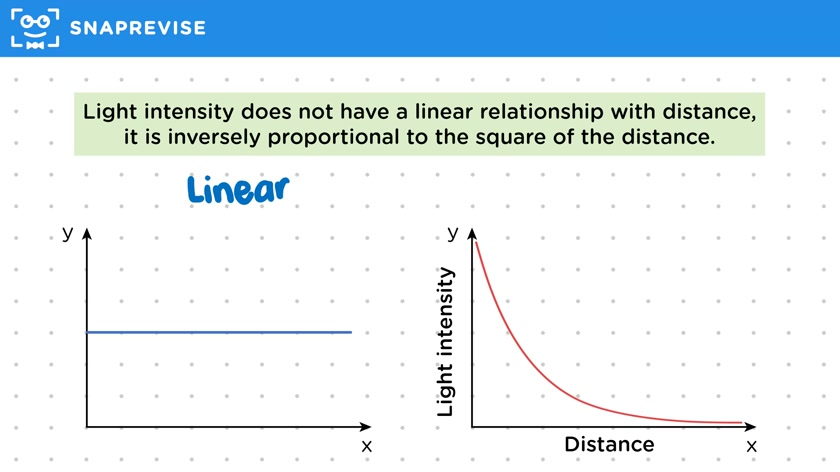
- The relationship between light intensity and distance is inversely proportional, meaning as one factor increases, the other decreases.
- Light intensity is inversely proportional to the square of the distance, not a linear relationship.
- Linear relationships result in a straight line graph, either positive or negative.
- The graph representing the relationship between distance and light intensity is non-linear, showing a decrease in light intensity as distance increases.
- This relationship is known as the inverse square law and can be represented by an equation.
- The equation states that light intensity is proportional to 1 divided by the distance squared.
- Doubling the distance from the light source results in the light intensity falling to a quarter of its original value.
- Understanding the inverse square law is important in the context of photosynthesis, though memorizing the equation or understanding the intricacies of the relationship is not necessary.
- Key points to remember include the effect of doubling the distance on light intensity and the term "inverse square law."
Please subscribe to access these revision notes.
This, and all other video notes, are included in our premium subscriptions.
Premium accounts get access to all videos and revision notes.
Report an Issue
Spotted something wrong? Let us know and we'll take a look.