
GCSE Biology (AQA)
331 videos | 14 hours
Please subscribe to watch this video.
This, and all other videos, are included in our premium subscriptions.
Premium accounts get access to all videos.
Enable autoplay to keep watching
Your browser is blocking videos from playing automatically. To turn it back on:
Safari (Mac): Click the Safari menu item in the top bar, then Settings → Websites → Auto-Play, then set Auto-Play to Allow All Auto-Play for the current website.
Safari (iPhone/iPad): open the Settings app, then Apps → Safari → Auto-Play, and select Allow All Auto-Play.
Cell Biology
Cell Structure
Cell Size
6:43
Understanding Sizes of Cells
Spec
4.1.1.1
4.1.1.2
- Animal and plant cells typically range from 0.01 to 0.1 millimeters in length.
- Examples given include a cheek cell for an animal cell and a leaf cell for a plant cell.
- Plant cells can grow much larger than animal cells.
- For exams, it's important to understand typical cell sizes rather than memorizing specific measurements.
- Bacterial cells are significantly smaller than both animal and plant cells, typically around 10 times smaller.
- Bacteria can form visible colonies when they accumulate in large numbers.
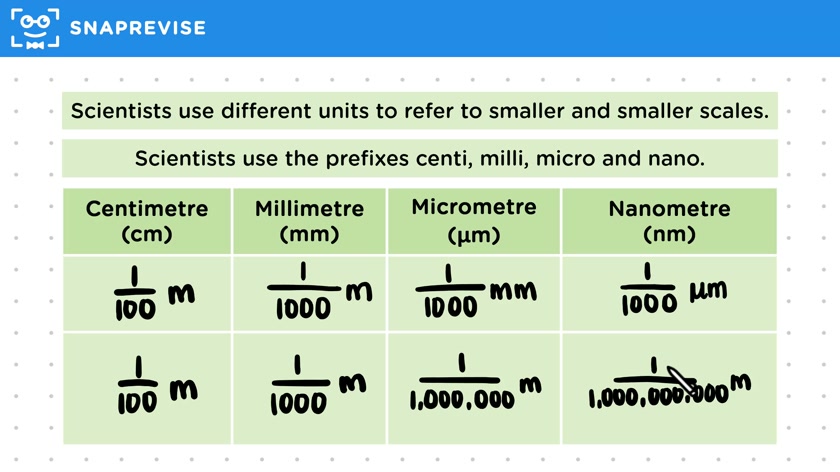
- Scientists use units such as centimeters, millimeters, micrometers, and nanometers to measure and compare cell sizes.
- Conversion between these units involves multiplying or dividing by factors of 10, 1000, or 1 million depending on the scale change.
- Cells are generally measured in micrometers, while smaller subcellular structures like ribosomes are measured in nanometers.
- The maximum size of ribosomes is about 30 nanometers.
Please subscribe to access these revision notes.
This, and all other video notes, are included in our premium subscriptions.
Premium accounts get access to all videos and revision notes.
Report an Issue
Spotted something wrong? Let us know and we'll take a look.