
GCSE Physics (AQA)
Topic Summaries
States of matter and heat capacity
States of matter
- The different states of matter can be explained using particle models of atoms and molecules.
- In a solid, the particles are all tightly packed in a rigid structure. They cannot move because of strong intermolecular forces but they can vibrate.
- In a liquid, these forces are slightly weaker. The particles stay in contact but they can move and flow. The liquid can change shape to fit a container.
- In a gas, the particles can freely move. They are spread out so the gas expands to fill any volume, and the forces between particles are very small.
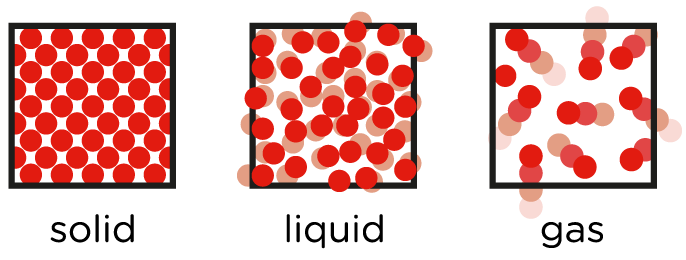
- Solids and liquids have high densities as atoms are tightly packed together. In gases, the density is much lower as the atoms or molecules are spread out.
- Substances can change state through various processes.
- During these, mass is conserved as the number of particles doesn’t change.
- These are physical processes because they are reversible and the substance does not change.
| Process | Change from... | To... |
| Melting | Solid | Liquid |
| Freezing | Liquid | Solid |
| Boiling/evaporating | Liquid | Gas |
| Condensation | Gas | Liquid |
| Sublimation | Solid | Gas |
Unlock States of matter
Sign up to unlock the rest of this topic — plus every other topic, video, flashcard set and eBook guide in your SnapRevise+ subscription.
Cancel anytime — instant access the moment you sign up.
Report an Issue
Spotted something wrong? Let us know and we'll take a look.