
GCSE Physics (Pearson IGCSE)
Topic Summaries
Radiation
Properties of radiation and ionisation
- Certain nuclei are unstable, meaning they will undergo radioactive decay and emit radiation to become more stable.
- This radiation can ionise atoms, causing them to become ions.
- Activity is the rate of radioactive decay, measured in Becquerels (emissions per second).
- Detectors, such as a Geiger-Muller tube, can measure radioactivity by counting the number of particles entering it. This will give a count rate as the number of decays recorded per second.
- Nuclear radiation comes in multiple forms:
- Alpha particles \((\alpha)\) consisting of two protons and two neutrons released from the nucleus (the same as a helium nucleus).
- Beta particles \((\beta)\) consisting of a high-speed electron. A neutron will turn into a proton to release this.
- Gamma rays \((\gamma)\) consisting of electromagnetic radiation from the nucleus.
- A neutron \((\text{n})\) released from the nucleus.
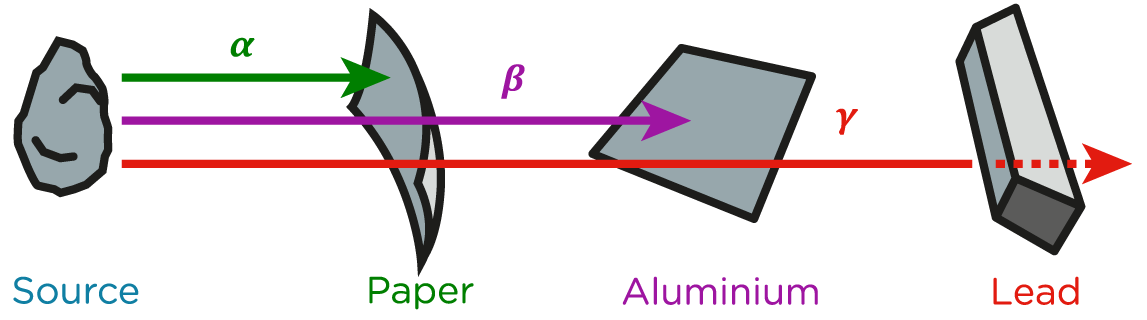
| Radiation | Range in air | Stopped by | Ionising power |
| Alpha | 5 cm | Paper | Strong |
| Beta | Several metres | Aluminium sheet | Medium |
| Gamma | Near infinite | Thick lead | Weak |
- Radiation is harmful to the body as it can damage cells and tissues.
- Alpha radiation is the most damaging inside the body as it is the most ionising.
- Gamma radiation is the most damaging outside the body as it can penetrate the body from far away.
Unlock Properties of radiation and ionisation
Sign up to unlock the rest of this topic — plus every other topic, video, flashcard set and eBook guide in your SnapRevise+ subscription.
Cancel anytime — instant access the moment you sign up.
Report an Issue
Spotted something wrong? Let us know and we'll take a look.