
GCSE Physics (CIE)
Topic Summaries
Properties of waves
Transverse and longitudinal waves
- Waves are used to transport energy or information. When a wave travels through a medium such as water or air, it is the wave and not the medium that is travelling.
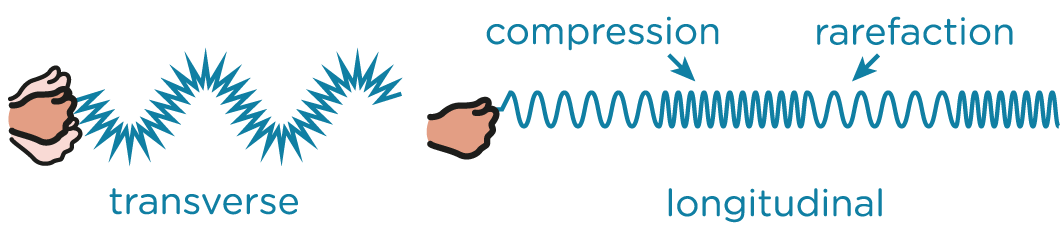
- Transverse waves are caused by vibrations that are perpendicular to their energy transfer. Examples of transverse waves are light and water ripples.
- Longitudinal waves are caused by vibrations that are parallel to the direction of energy transfer.
- Longitudinal waves consist of compressions, where matter is pushed together, and rarefactions, where it is pulled apart.
- Sound is an example of a longitudinal wave. It is produced by a vibrating object and travels through air by creating compressions and rarefactions in it.
Unlock Transverse and longitudinal waves
Sign up to unlock the rest of this topic — plus every other topic, video, flashcard set and eBook guide in your SnapRevise+ subscription.
Cancel anytime — instant access the moment you sign up.
Report an Issue
Spotted something wrong? Let us know and we'll take a look.