
GCSE Computer Science (CCEA)
Topic Summaries
COMPUTER SYSTEMS: Systems architecture
The fetch-execute cycle
- The CPU accomplishes its tasks by running something called the fetch-execute cycle, sometimes also called the fetch-decode-execute cycle.
- The faster the CPU can run this cycle, the faster the computer can run tasks. The average computer can run this cycle billions of times a second!
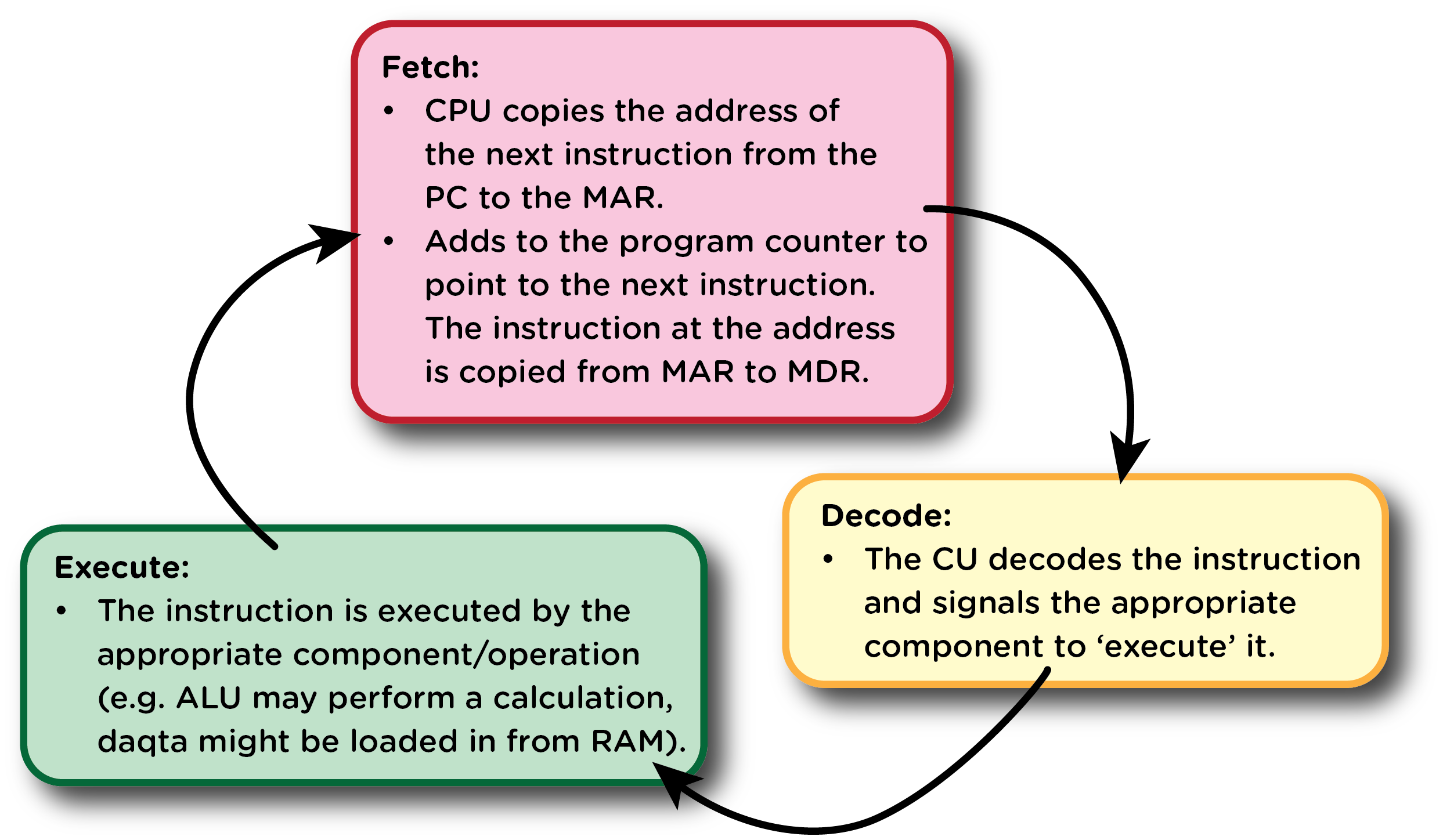
- Fetch:
- The program counter (PC) holds the address of the next instruction and sends this to memory access register (MAR).
- The instruction is retrieved from main memory and placed into the memory data register (MDR), and copied to the current instruction register (CIR).
- Decode:
- The control unit (CU) interprets the instruction stored in the CIR.
- The CU identifies the required operation and the necessary data, registers, or addressing mode.
- Execute:
- The indicated operation is carried out: arithmetic/logic operations (via the ALU), data transfer, or control flow.
- Results are written back to registers or memory as required.
- The cycle then repeats for the next instruction.
Unlock The fetch-execute cycle
Sign up to unlock the rest of this topic — plus every other topic, video, flashcard set and eBook guide in your SnapRevise+ subscription.
Cancel anytime — instant access the moment you sign up.
Report an Issue
Spotted something wrong? Let us know and we'll take a look.